.svg)


Slope stabilization on steep construction sites is a permit requirement and a critical schedule dependency. Failure to stabilize can shut down a project within hours of heavy rainfall. Modern techniques are essential for challenging terrain.
Sediment runoff leads to heavy fines, rework, and downstream damage that impacts project timelines and budgets. We bring 35 years of experience to highway embankments and industrial corridors. We serve the four-state region with specialized solutions.
Why Slopes Fail: Mechanics of Instability
Failure starts with changes in water pressure and soil strength. These factors erode the Factor of Safety (FOS) until the slope can no longer hold itself together.
Soil Shear Strength and Saturation
Clay soils have high cohesion but low permeability, often leading to deep-seated rotational slides when saturated. Rain fills soil voids, increasing pore water pressure. This reduces the effective stress holding the soil mass in place.
Sandy soils lack cohesion and suffer from rapid surface raveling and rilling. Geometry changes also impact stability; excavation at the toe removes support, while adding fill at the crest increases driving forces.
Watch for tension cracks at the crest or bulging at the toe. Surface rilling often indicates groundwater migration and internal pressure buildup that precedes a slide.
Evaluating Site Conditions and Drainage Control
Geotechnical analysis determines the FOS ratio. Most permanent slopes require a factor of 1.3 to 1.5 to meet regulatory safety and engineering standards.
Managing Water Velocity
Controlling water velocity is often more effective than structural reinforcement. Interceptor ditches at the crest catch runoff before it can gain speed down the face. Lined channels and slope drains safely transport water to the bottom.
Diversion berms are also used to direct flow away from vulnerable, newly seeded areas. Subsurface drainage, like French drains, lowers groundwater levels. This increases shear strength and prevents saturated soil from sloughing under its own weight.
Structural Measures for High-Risk Slopes
When geometry exceeds soil limits, structural intervention is required. Retaining walls are used when space constraints prevent grading at stable, natural angles. Options include gravity walls, cantilever walls, and mechanically stabilized earth (MSE).
These systems use geosynthetics to provide the necessary tensile strength to the soil. Soil nailing and ground anchors reinforce the internal soil mass. These methods are typically specified for steep cut slopes or deep excavations in urban areas.
The Science of HP-FGM and Hydroseeding
High Performance-Flexible Growth Media (HP-FGM) like Flexterra provides immediate surface protection. It bonds directly to the soil, creating a continuous "growth skin."
Chemical Bonding and Growth Skin
HP-FGM uses cross-linking hydro-colloidal polymers to create a mechanical and chemical bond. This erosion-resistant matrix resists heavy rainfall and Gulf Coast weather, maintaining integrity under high-flow conditions.
Hydroseeding delivers seed, mulch, and fertilizer in one slurry. As the mixture cures, it forms a mechanical bond with the soil surface to prevent seed washout.
Root networks eventually bind the soil, providing long-term biological reinforcement. This transition from mechanical to biological stability is the goal of every project.
Climate-Specific Seeding and Native Species
Native grass seeding is ideal for highway embankments and large-scale industrial sites. These species develop deep roots and require minimal irrigation after establishment. Seed mixes are customized for the regional climate.
Arid regions in West Texas and New Mexico require drought-tolerant species that can survive long dry spells. Humid environments in Louisiana and East Texas need species that handle high moisture and rapid growth. We match the biology to the local environment.
Installation Best Practices and Execution
Successful stabilization requires proper surface preparation. Track-walking creates horizontal grooves that catch seed and increase the surface area for hydraulic bonding.
Surface Preparation and Top-Down Application
We use a "top-down" application technique to ensure complete coverage. This prevents the shadow effect, where gaps are left behind small rocks or soil clumps. Stormwater permits require controls within days of disturbance.
Our hydraulic methods provide same-day protection for immediate site compliance and peace of mind. We install 15 million square feet of mulch annually. We follow TxDOT specifications and project-specific geotechnical recommendations to ensure long-term site stability.
Regulatory Compliance and SWPPP
Stormwater Pollution Prevention Plans (SWPPP) mandate strict erosion control measures. Our high-performance mulches meet or exceed the requirements for "final stabilization." Using hydraulic stabilizers can reduce the need for plastic netting and silt fences.
This lowers the long-term maintenance burden and prevents wildlife entanglement issues. Regular inspections are required after significant rain events. We provide the documentation and performance history needed to satisfy local and federal environmental inspectors.
Request a project estimate or call 281-482-8212 to discuss your specific site conditions and needs.
Frequently Asked Questions
What are the first signs of slope failure?
Look for tension cracks parallel to the crest or bulging soil at the toe. Seeps or deep rilling suggest driving forces are exceeding soil stability.
How do I choose between blankets and hydraulic binders?
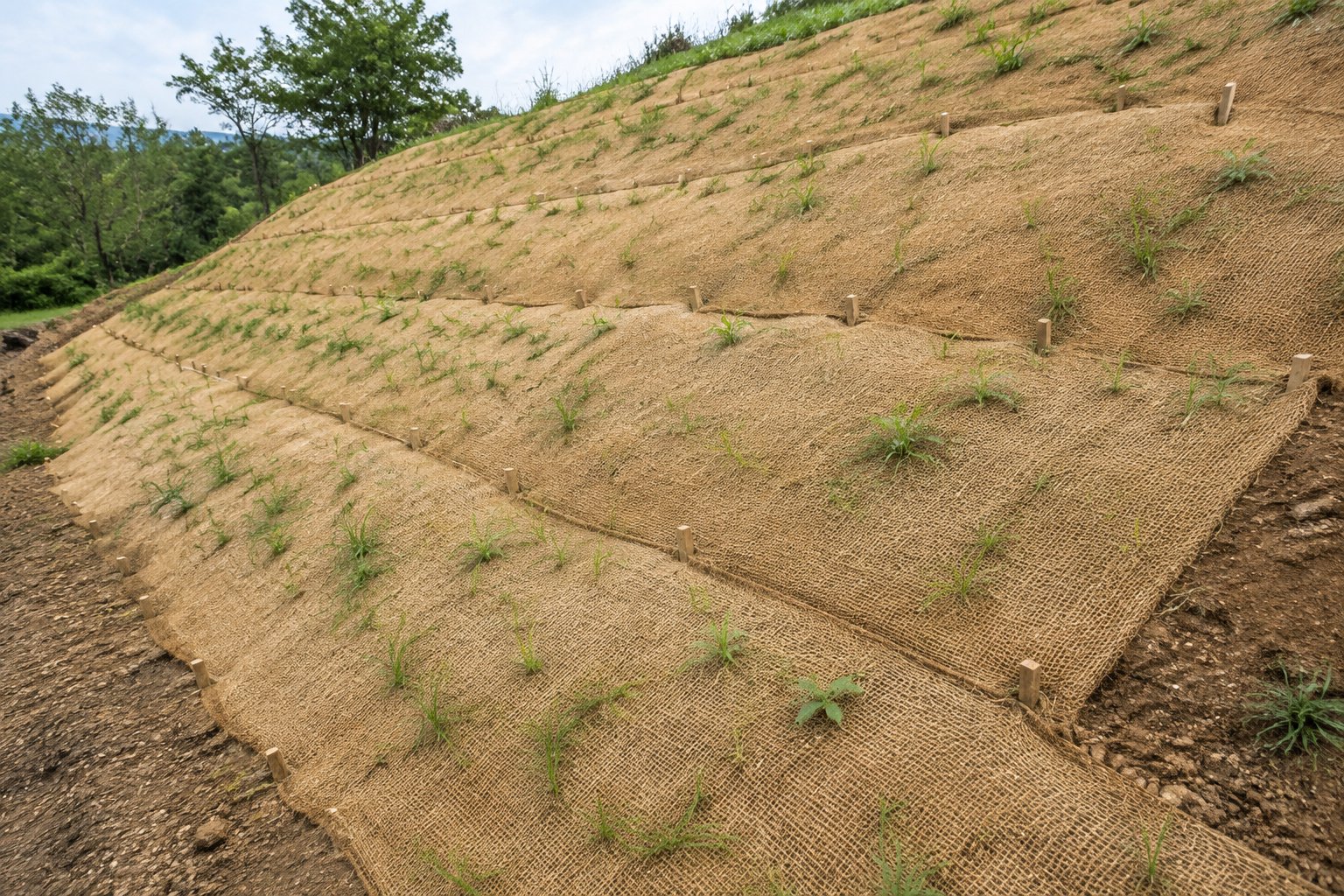
Blankets work for moderate slopes with easy access. Hydraulic stabilizers like Flexterra are better for steep, rocky, or irregular grades where manual installation is difficult.
When is structural reinforcement necessary?
If the Factor of Safety is below 1.3 or deep instability is present, use soil nails. Surface treatments should still be applied to control sediment and surface erosion.
Why does seeding often fail on steep slopes?
Smooth, compacted soil prevents proper seed contact. High-performance mulch or erosion blankets are needed to hold seed in place through the critical germination window. Use our online job calculator or call 281-482-8212 for specialized assistance with your project.