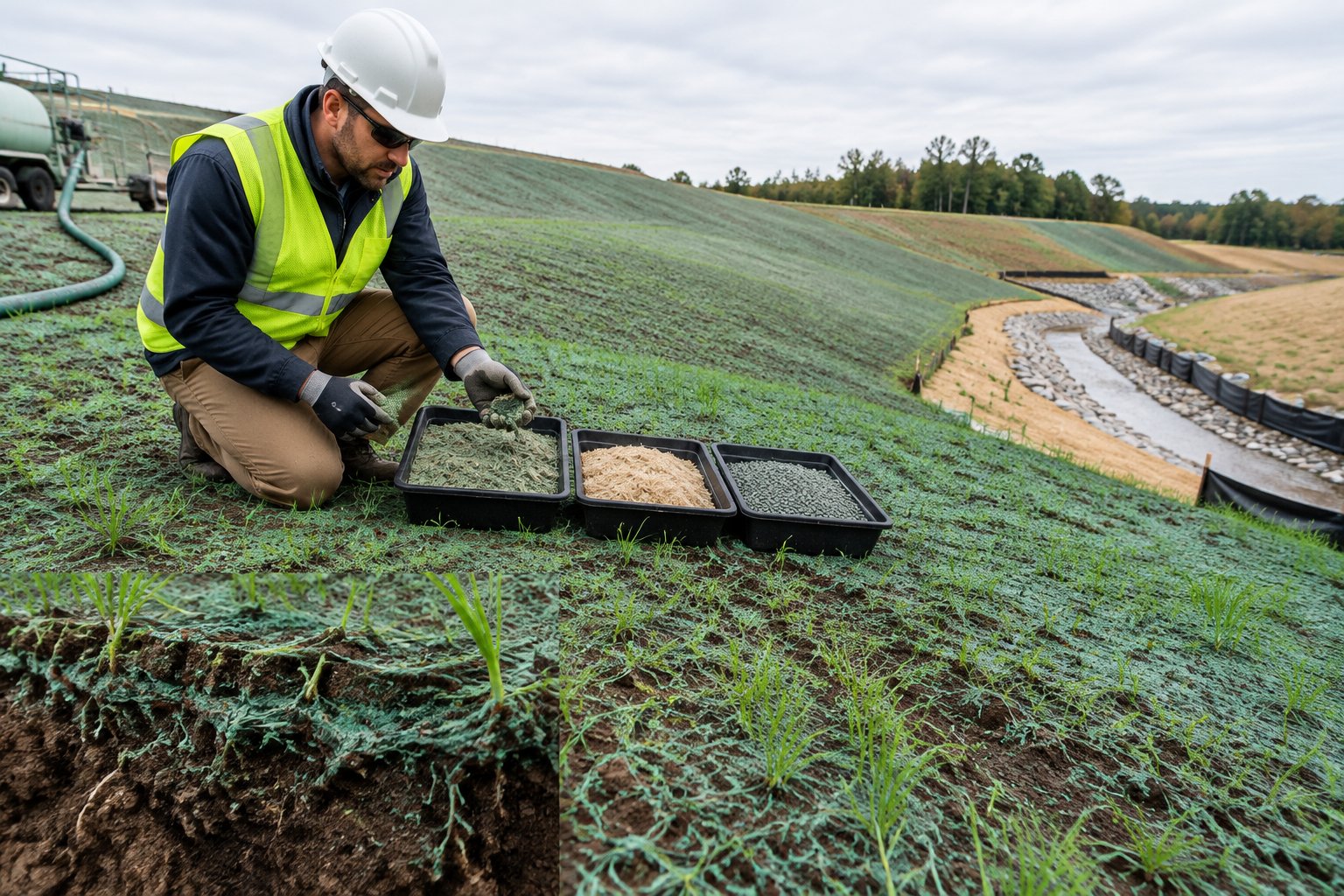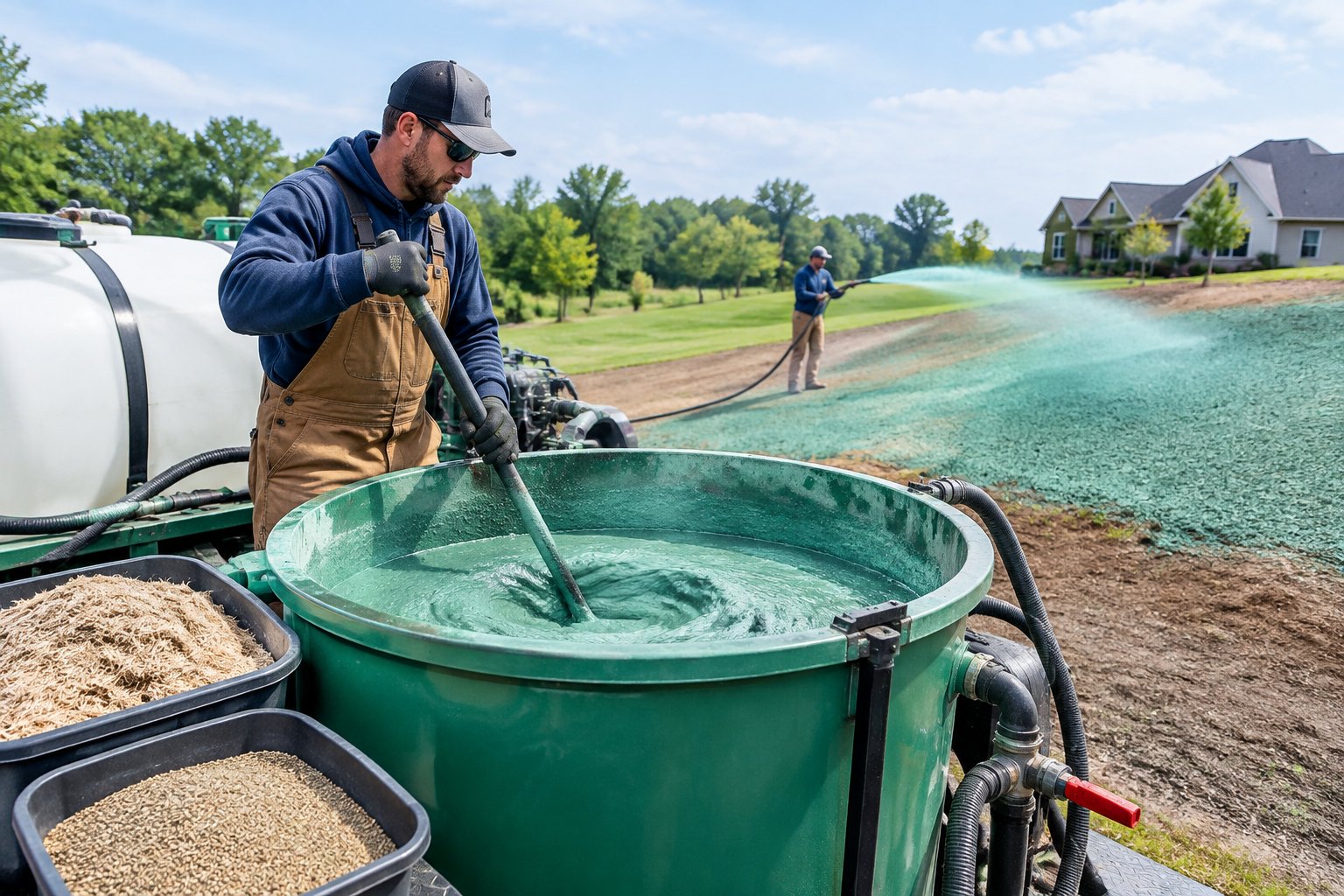



Erosion control blankets are rolled mats of straw, wood excelsior, coconut fiber or synthetic material that are stapled over seeded soil to hold it in place until vegetation takes over. They are at their best in swales, ditches and short, steep faces where water concentrates. Across the rest of a typical commercial site, spray-applied cover such as hydraulic mulch, bonded fiber matrix (BFM) or Flexterra HP-FGM usually protects the same ground faster and with far less hand labor. Most well-run jobs use both, each where it fits.
This article walks through the main blanket types, how they compare with spray-applied options, and how to split a whole site between them so you are not paying blanket labor on ground that a hose could cover in an afternoon.
What Types of Erosion Control Blankets Are There?
Blankets are sorted mainly by what they are made of, which sets how long they last and how much flow they can take, and by the netting that holds the fibers together.
Straw Blankets
Straw is the most common and lowest-cost blanket. It suits moderate slopes with sheet flow and areas where grass is expected to establish within a season or so. Straw breaks down fastest of the natural fibers, which is fine as long as vegetation is ready to take over.
Excelsior (Wood Fiber) Blankets
Excelsior is made from curled wood shavings that interlock and hold soil contact well. It lasts longer than straw and is a common choice for steeper grades and light channel work where a little more durability is needed.
Coir and Straw-Coconut Blends
Coconut fiber breaks down slowly and has more strength than straw, so coir blankets are specified for steep embankments, streambanks and channels with heavier runoff. Straw-coconut blends split the difference, lasting longer than straw and costing less than full coir.
Synthetic Blankets and Turf Reinforcement Mats
Synthetic blankets use polypropylene or similar fibers for longer service while vegetation establishes. Turf reinforcement mats (TRMs) are a separate class: nondegradable three-dimensional mats designed to stay in the ground permanently and reinforce the grass root zone. TRMs are specified for channel linings and other areas with high, sustained flow, sometimes in place of rock.
Netting: Single, Double and Biodegradable
Single-net blankets suit gentler slopes. Double-net products hold together better on steeper ground and in channels. Many blankets also come with biodegradable netting, which is worth considering near wetlands or anywhere loose plastic mesh could cause problems for wildlife or for mowing later.
Always check the manufacturer's rating for slope and flow against the area you are covering. The product data sheet, not the material name, tells you whether a blanket is suited to the job.
How Do Blankets Compare with Spray-Applied Protection?
Both approaches protect soil while vegetation establishes. They differ most in labor, speed and how they handle concentrated water.
The biggest practical difference on a big site is production. One hydroseeding crew can cover acres in a day, while blanket crews work roll by roll. On curved grading, around inlets and along pad edges, every blanket roll has to be cut, overlapped and anchored, and each of those seams is a place water can get underneath.
How Should You Split a Whole Site Between Blankets and Spray?
Think in zones rather than picking one product for the whole job.
- Flat pads, lots and gentle slopes. Standard hydraulic mulch with seed. This is usually the largest share of the disturbed area and the cheapest to cover.
- Long or steep slopes with sheet flow. BFM or Flexterra HP-FGM, sprayed from the truck. You get continuous cover without putting a crew on a slope that is hard to walk.
- Swales, ditches and outfalls. Blankets or TRMs rated for the flow, trenched and stapled. Our guide to erosion control in drainage channels covers how to choose the lining.
- Transitions. Where a sprayed slope meets a blanketed channel, overlap the protection so there is no strip of bare soil between them.
If a steep slope has been specified for blankets and you are weighing who should install them, our contractor selection guide for erosion control blankets on steep slopes covers that decision. For a quick ballpark on the hydroseeded portion of your site, our pricing calculator gives a rough range for standard hydroseeding.
What Makes a Blanket Installation Hold?
A blanket only works while it stays tight against the soil. Most failures trace back to installation rather than the product.
- A smooth seedbed. Rocks, clods and ruts hold the blanket off the ground and let water run underneath. Seed, fertilizer and any lime go down before the blanket unless it is a pre-seeded product.
- An anchor trench at the top. The upslope end is buried and stapled so runoff from above cannot get under the first roll.
- Shingled overlaps. The upslope or upstream roll lies on top of the one below it, so water runs over each seam instead of into it.
- The manufacturer's staple pattern. Staple density depends on the product, slope and soil, and channels need more anchoring than slopes.
- Full soil contact. Walk the blanket down after stapling and add staples anywhere it bridges a low spot.
How Often Should Blanketed Areas Be Inspected?
Inspect at the frequency your SWP3 requires and after significant rain until vegetation holds the soil. Look for tenting where the mat has lifted, rills under the blanket, pulled staples and shifted overlaps. Repairs are simple when they are caught early: pull back the blanket, fill and tamp the rill, reseed and re-staple. Left alone through another storm, the same spot can turn into a gully that takes out the rolls below it.
Get a Coverage Plan for Every Zone on Your Site
Allied Hydromulch has been providing erosion control services for contractors, developers and municipalities across Texas and Louisiana since 1990. We can look at your grading plan and help you decide where spray-applied cover makes sense and where the water calls for something heavier. Contact Allied Hydromulch or call 281-482-8212 to talk through your site.
Frequently Asked Questions
Do erosion control blankets have to be removed?
Natural fiber blankets are designed to break down in place as vegetation takes over, so they are normally left alone. TRMs stay permanently by design. Check the project spec for any area where netting has to be removed before mowing or turnover.
Are blankets cheaper than hydromulch?
Usually not on large areas, because blankets carry much more installation labor per square foot. On a small ditch or a short slope, the difference narrows, and in concentrated flow a rated blanket may be the only option that holds.
Can you hydroseed instead of using a blanket on a slope?
Often, yes. Bonded hydraulic products such as BFM and Flexterra are used on many slopes that might otherwise be blanketed. Areas with concentrated flow are the exception, and the engineer's spec decides what is allowed.
Will grass grow through an erosion control blanket?
Yes. Seed placed under the blanket germinates and grows up through the open fiber structure, provided the blanket has good soil contact and the seed gets steady moisture.