.svg)


A ditch that scours out after the first heavy rain does more than move dirt. It drops sediment into receiving waters, undercuts the channel bank, and puts your stormwater inspection at risk. Erosion control in drainage channels comes down to one question: will the lining you specify hold the shear stress that flowing water puts on the channel bed?
For many roadside ditches and low-flow swales in Texas, a vegetated lining, established with seed and a temporary cover rated for the expected flow, handles the job at the lowest installed cost when the hydraulic design shows the flow stays within its limits. Concentrated flow, steep grades, or velocities past what grass can tolerate call for erosion control blankets, turf reinforcement mats, riprap, gabions, or concrete.
Getting that call right starts with flow data, not a product catalog. Channel slope, soil type, drainage area, and the design storm all feed into the calculation. TxDOT's design procedure compares maximum shear stress at normal depth against the permissible shear stress for the lining you pick, and if the lining can't take it, you change the lining or change the channel.
That analysis belongs to the project's engineer. Allied Hydromulch installs the seeding, hydraulic products, and blankets the design calls for; we do not perform hydraulic design or engineering.
What follows walks through how flow conditions narrow the options, which linings fit which sites, and where seeded vegetation carries the long-term load.
How Do Flow Conditions and Channel Geometry Drive Stabilization Choices?
Water velocity and shear stress decide the lining. Everything else is detail. A wide, flat-bottomed ditch on a 0.5 percent grade puts far less force on the soil than a narrow channel on a 6 percent grade carrying the same flow.
Assessing Open Channel Flow, Velocity, and Shear Stress
Open channel flow analysis starts with hydrologic analysis to establish the design discharge. Small drainage areas often use the rational formula. Larger watersheds need regional regression or modeled methods.
Once you have the discharge, Manning's equation gives flow depth and velocity using the channel geometry, slope, and Manning's roughness coefficient for the lining. Grass linings have high roughness. Concrete has low roughness and produces much faster flow.
Shear stress follows from flow depth and channel slope. TxDOT's roadside channel design procedure states that if computed shear stress exceeds the permissible shear stress for the lining, you choose a more resistant lining, flatten the slope, add drop structures, or widen the channel.
Freeboard matters too. The channel needs depth above design water surface so a larger event does not overtop the bank and cut a new path down the side slope.
How Channel Slope, Soil Type, and Drainage Area Affect Risk
Three site variables drive most channel failures we see on Texas jobs:
- Slope. Steeper grade means higher velocity and higher shear stress on the same cross section.
- Soil. Fine sands and silts erode at lower velocities. Gulf Coast clays resist scour better but shed water fast, which raises peak flow.
- Drainage area. More contributing acreage means more discharge, and discharge grows as upstream grading strips vegetation.
Soil texture drives temporary product selection as well. TxDOT's erosion prevention methods guidance notes that soils with higher percentages of fine sand or silt are increasingly erosive, and that soil type plus slope determine the appropriate temporary measure.
Why Culvert Outlets, Bends, and Transitions Need Extra Attention
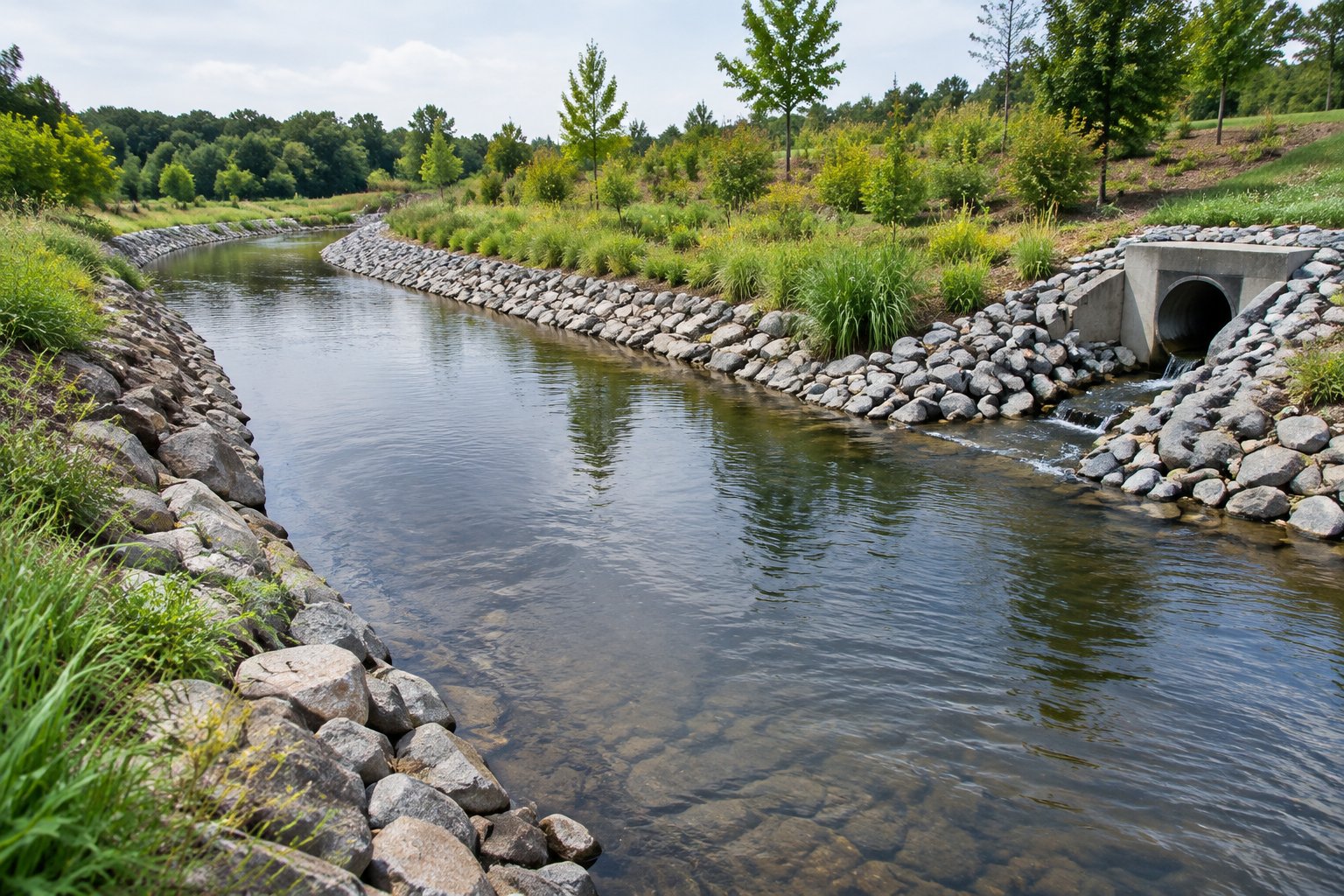
Culvert outlets concentrate flow into a small area at high velocity, and scour there is a common occurrence. Energy dissipation is the fix. Options range from riprap aprons to a formal energy dissipator such as a stilling basin that forces a hydraulic jump.
Froude number at the outlet tells the designer which dissipator class applies. The Federal Highway Administration publishes its hydraulic design guidance for energy dissipators at culverts and channels as HEC 14, and state manuals reference it directly.
Bends deserve the same scrutiny. Flow piles up on the outside of a curve, raising local shear and overtopping risk. Keep alignment changes gradual and place them on flatter grades where practical.
Which Channel Linings Fit the Site Conditions?
Channel linings split into two families: rigid and flexible. Rigid linings resist high-magnitude erosive force. Flexible linings conform to a changing channel shape, cost less to install, and permit infiltration.
Vegetated Linings for Low to Moderate Flow Areas
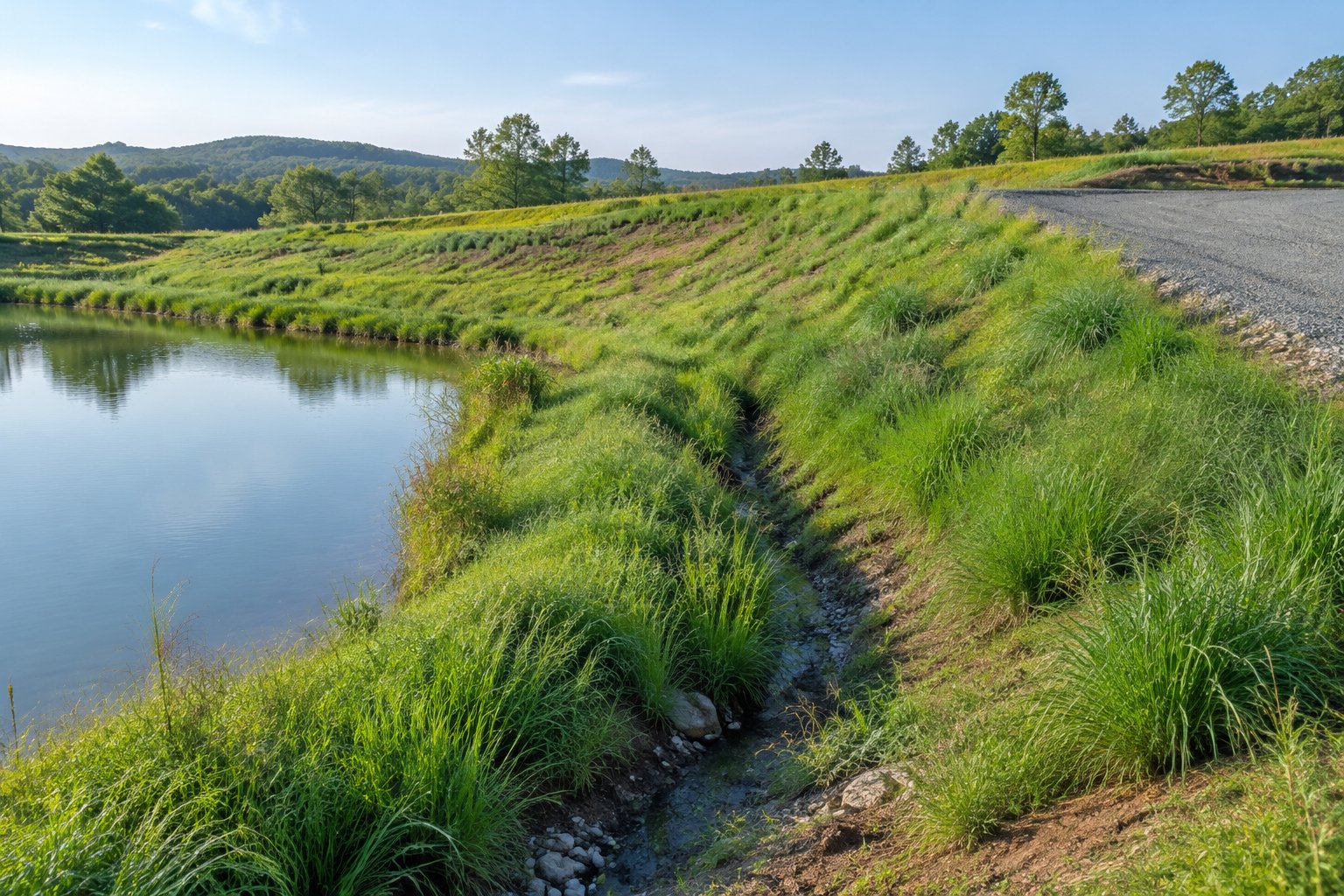
Grass works as a permanent channel lining when flow depth, velocity, and soil type stay inside acceptable tolerances for vegetative lining. That covers a large share of roadside ditches, parking lot swales, and detention outfall channels on commercial sites.
Turf can be established by sodding or seeding. Sod costs more but gives immediate protection. Seeding costs less and usually needs a temporary protective covering until the stand establishes.
Retardance class matters in the calculation. A tall, dense stand of Bermuda grass or a native grass mixture carries a different roughness and permissible shear value than a thin new seeding.
Erosion Control Blankets and Turf Reinforcement Mats
Blankets and mats bridge the gap between bare seeded soil and a fully established stand. TxDOT groups channel liners and soil retention blankets into organic or organic composite products and synthetics.
Organic and composite products support vegetation establishment and offer no long-term channel protection. Synthetic materials last longer, work with the root matrix, and provide permanent erosion control. Synthetics are preferred in ditches and channels that see frequent flows deeper than 8 inches. Flow depth is only one input, though: selection has to follow the project's hydraulic requirements and each product's tested performance, including its permissible shear stress.
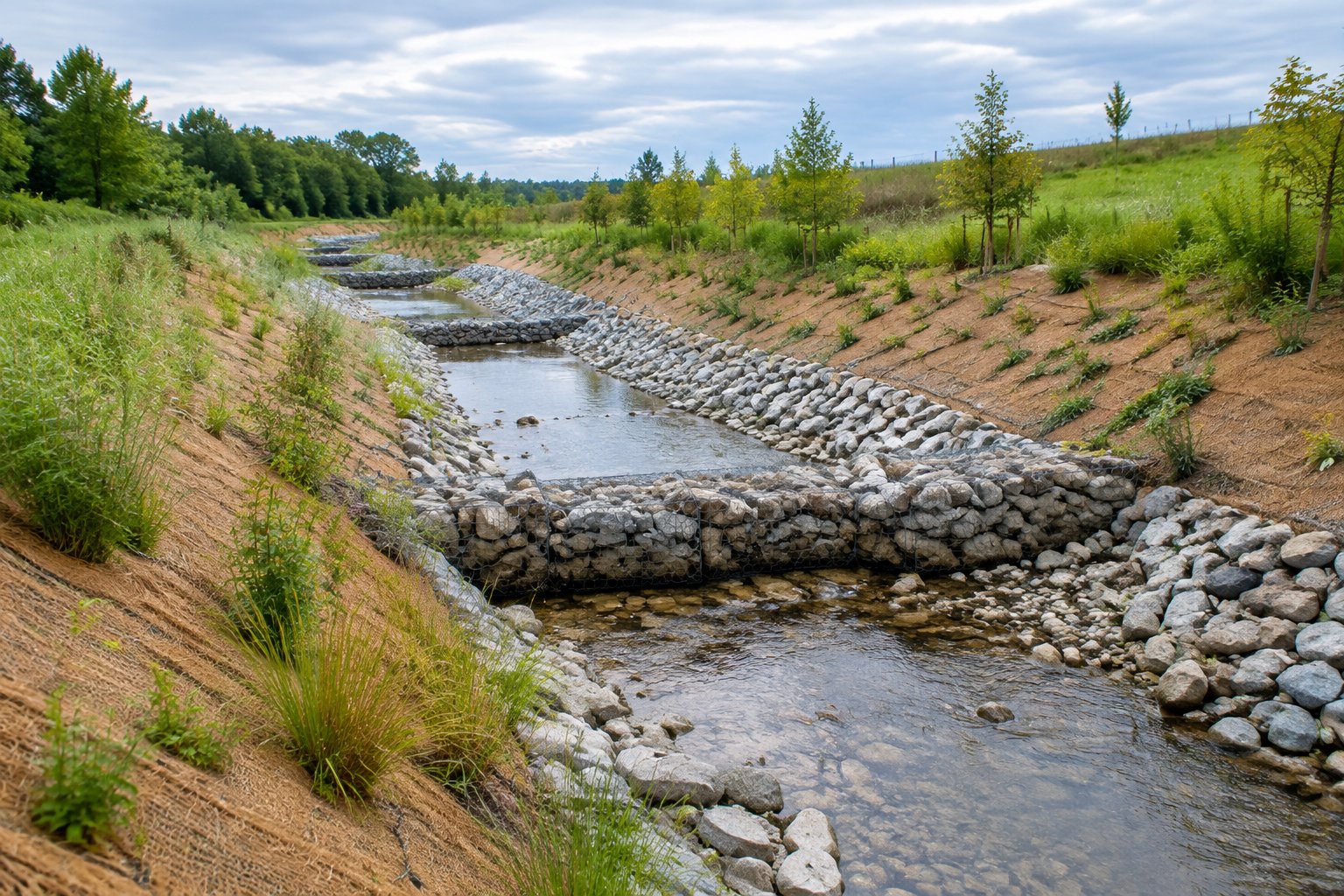
Turf reinforcement mats fall in that synthetic group. The root system grows through the mat structure, so the finished lining carries more shear than vegetation alone. Products are approved on shear stress ratings for channel protection, which is the number to check against your computed value.
Installation controls performance. Anchor patterns, upstream trenching, and overlap details all decide whether water runs over the mat or under it.
When Riprap, Gabions, Concrete, or Paved Ditches May Be Needed
Some channels exceed what any vegetated system can hold. That is where rock and hard armor earn their cost:
- Rock riprap. Flexible, self-healing, common at culvert outlets and on steep reaches.
- Gabion baskets and gabion mattresses. Wire-enclosed riprap for bank protection and tight cross sections.
- Concrete lining and paved ditches. Rigid, high capacity, used where right-of-way limits channel width.
Rigid linings carry trade-offs. Initial cost usually exceeds flexible linings. Maintenance can run high because rigid linings are vulnerable to undercutting and hydrostatic uplift. Smooth surfaces raise velocity, which pushes scour to the end of the paved section unless riprap or a dissipator catches it.
Cost also scales fast. Protective linings for channels and streams can be very expensive, so a composite approach, hard armor in the invert and vegetation on the side slopes, often lands closer to budget.
Planning Drainage Channel Erosion Control With Vegetation
Vegetation is the permanent lining on most drainage channels, and the seeding method decides how fast it gets there. Planning erosion control in drainage channels should set a target date for cover, then work backward to the application window.
Where Hydroseeding and Hydraulic Mulch Support Establishment
Hydroseeding puts seed, mulch, fertilizer, and soil conditioners down in one hydraulic application over prepared soil. The mulch layer holds moisture at the seedbed, which is exactly what a freshly graded ditch bottom lacks.
With favorable temperatures and moisture, germination often begins within 7 to 14 days, and a usable cover can develop in 4 to 6 weeks depending on weather and irrigation. A new stand is not the same as a mature lining, so that approach fits side slopes above the flow line, and swales or roadside channels only where the design shows flows stay within the tolerance of the temporary cover and young vegetation.
Hydraulic mulch has limits in the invert. Straw and wood chip mulch tacked with asphalt is not well suited to channel invert lining, though it serves on side slopes. On steep side slopes and disturbed soils where standard hydraulic mulch will not hold, we install Flexterra flexible growth medium; our Flexterra erosion control installation work covers those conditions. Neither standard hydraulic mulch nor a BFM or FGM product automatically suits concentrated channel flow. Any hydraulic product used in or near the flow line has to be approved for that use in the design, based on its tested performance.
We mulched approximately 15 million square feet in 2025 for more than 60 unique clients.
When Native Grass Seeding Supports Long-Term Channel Protection
Native grasses build the root structure that holds a channel over decades. Established stands of native grasses provide long term erosion control because their deep, fibrous root systems reach soil moisture that shallow-rooted introduced grasses cannot.
Native grass seeding often germinates in about 2 to 4 weeks, and establishment can take several months. Plan for that slower curve and pair it with temporary protection. Contractors working reclamation and right-of-way projects can review our approach to native grass seeding for commercial sites.
Irrigation ditches, highway corridors, and large rural tracts benefit most. Low maintenance demand and drought tolerance reduce long-term mowing and repair. Our roadside corridor stabilization projects lean on the same principle.
Matching Temporary Protection to Permanent Vegetative Cover
Ditch erosion control works in two stages. Temporary products carry the channel through the establishment window. Permanent cover carries it after.
- Temporary flexible linings: straw with net, curled wood mat, jute or synthetic net, fiberglass roving, geotextile fabrics.
- Permanent flexible linings: rock riprap, wire-enclosed riprap, vegetative lining, geotextile fabrics.
The sequencing question is simple. Does the temporary product last long enough for the seed to establish under the flows expected during that window? A 45-day blanket paired with a native grass mix that needs 90 days leaves a gap.
Coordinating Stormwater Control, Sediment Control, and Construction Sequencing
Channel stabilization is one line item inside a larger water management plan, and the sequence decides whether it holds. A finished channel lining installed before upstream grading wraps up will fill with sediment or wash out.
Protecting Receiving Waters During Active Grading Work
Stormwater runoff picks up sediment, debris, and chemicals as it crosses a construction site, then deposits them in creeks, streams, and rivers. Drainage channels are the delivery route.
Sediment control keeps material out of the channel while erosion control keeps the channel itself intact. Both belong in the plan:
- Silt fence or another properly specified sediment barrier at disturbed boundaries
- Rock filter dams and sediment traps in the drainage path
- Outlet protection at culverts and pipe ends
- Stabilized construction exits to cut track-out
- Soil stabilization on graded areas as work areas close
Runoff interception matters upstream of a new channel. Diverting clean water around the work area lowers the load the temporary lining has to carry. Our guidance on silt fence installation covers the perimeter side of that work.
Using the SWPPP to Coordinate Stabilization Measures
The Storm Water Pollution Prevention Plan (SWPPP, written as SWP3 in Texas) is where channel work gets scheduled against grading phases. Construction activity that discharges stormwater to surface water in the state and disturbs one acre or more, or is part of a larger common plan of development that does, falls under the Construction General Permit TXR150000, issued by the Texas Commission on Environmental Quality (TCEQ) with an effective date of March 5, 2023.
Final stabilization under that permit means a uniform perennial vegetative cover at a density of at least 70 percent of native background vegetative cover on unpaved areas, or equivalent permanent measures such as riprap or gabions.
That 70 percent threshold is why seeding timing belongs on the schedule. Our post on stormwater compliance erosion control covers inspection readiness in detail.
When a Professional Site Assessment Is Needed
Bring the project engineer into the conversation, and let your installer know, when any of these apply:
- Computed velocity or shear stress sits near the permissible limit for the proposed lining
- The channel receives culvert discharge or has bends on steep grades
- Grading will change the contributing drainage area
- Spec calls for a shear rating you have not matched to an approved product
- The channel drains to an impaired water body with total maximum daily load requirements
Field conditions can differ from the plan set. When our crews see a mismatch during installation, we raise it with the project team so the engineer can decide how to address it. Ray has been with Allied since 1992, and Josh since 2009.
Selecting a Channel Solution That Holds Through the Project Schedule
The channel lining decision rests on numbers the project engineer calculates: design discharge, flow depth, velocity, and shear stress against the permissible value for each candidate lining. Vegetated linings handle low and moderate flow ditches at the lowest cost. Blankets and turf reinforcement mats extend that range. Riprap, gabions, and concrete take the reaches that exceed it.
Permanent erosion control in a stormwater runoff channel depends on getting vegetation established before the channel takes real flow. Germination windows, seasonal rainfall, and your grading sequence all push against each other. Building that overlap into the schedule early costs less than repairing a scoured ditch after an inspection finding.
Allied Hydromulch TX, LLC has handled hydroseeding, native grass seeding, and erosion control installation across Texas and the Gulf Coast since April 1990, including channel linings installed to the project's design. Channel work is priced through a project quote: call 281-482-8212 or send your plans, lining specification, channel grades, and soil information. If adjacent areas only need standard hydroseeding, Allied's calculator gives a rough estimate from the project size in square feet.
Frequently Asked Questions
How Do You Keep a Drainage Ditch From Eroding?
Match the lining to the shear stress the flow creates, then keep it protected until vegetation establishes. Drainage ditches with low to moderate flow can hold with seeded grass plus a temporary cover rated for the expected flow, as the design specifies. Higher velocity reaches need synthetic mats, riprap, or a rigid lining.
What Is the Best Lining for a Stormwater Runoff Channel?
There is no single lining that fits every channel, so the choice follows the computed shear stress and the channel's service life. Vegetated linings cost least and perform well within their tolerance range. Rigid linings resist higher force but raise velocity and can cause scour at the downstream end.
When Is an Erosion Control Blanket Enough for a Drainage Channel?
An organic or composite erosion control blanket works when it only needs to protect seed during establishment and the channel sees shallow, infrequent flow. Channels with frequent flows deeper than 8 inches generally call for synthetic materials that provide long term protection with the root matrix. Flow depth is only one factor; the choice should follow the project's hydraulic design and the product's tested performance.
When Should Riprap or Gabions Be Used in a Channel?
Use riprap or gabions where velocity and shear stress exceed what vegetation and mats can tolerate, and at culvert outlets where flow concentrates. Both are flexible linings with self-healing qualities, so they tolerate minor shifts in channel shape. They also count as equivalent permanent stabilization under Texas construction stormwater permitting.
Can Hydroseeding Stabilize a Drainage Ditch?
Yes, on ditches and side slopes where the design shows flow stays within the tolerance of a vegetative lining and its temporary cover. Under favorable conditions, germination often begins within 7 to 14 days, and a usable cover can develop in 4 to 6 weeks depending on weather and irrigation; a mature lining takes longer. Channel inverts carrying concentrated flow need a blanket, mat, or hard armor alongside the seeding.
When Should a Contractor Request a Professional Channel Assessment?
Request a review from the project's engineer when computed values sit close to the permissible shear limit, when grading will change the drainage area, or when the spec names a shear rating you have not matched to a product. Culvert outlets, bends on steep grades, and discharges to impaired waters also justify an engineering review before installation.