.svg)


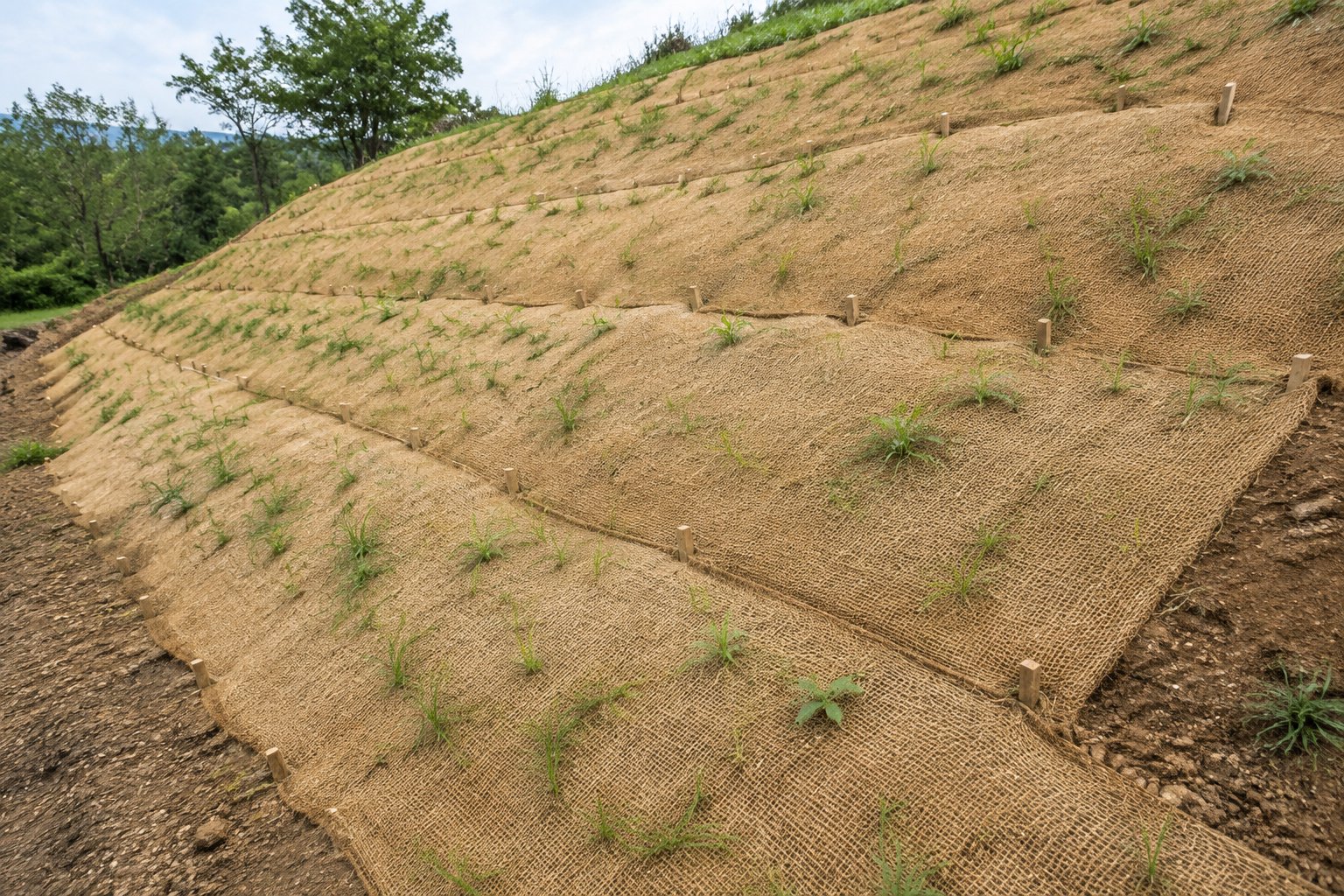
A 2H:1V cut slope on a Texas jobsite can lose its topsoil in one afternoon thunderstorm. The blanket spec you choose decides whether seed stays put or ends up in the ditch line.
There is no universal blanket-by-slope answer. Straw, straw-coconut, and coir (coconut fiber) blankets can all work on steep Texas slopes, but fiber type alone does not establish suitability. The right product is the one whose tested performance covers the slope gradient, slope length, expected flow, and service life on your site, installed to the manufacturer's and project's details.
Choosing an erosion control blanket for steep slopes comes down to a handful of site facts: slope gradient and length, expected rainfall and runoff, soil type, and how long you need protection before vegetation carries the load. Those facts are then checked against the specific product's tested performance and the project specification. Get them right and the installation holds. Guess on one and you are re-mobilizing a crew.
Erosion control blankets sit in a product family called rolled erosion control products (RECPs). The USDA Natural Resources Conservation Service separates these into erosion control blankets and turf reinforcement mats, with blankets used for temporary protection and mats used where protection must be permanent.
Start With Slope Risk and Required Protection
Slope risk drives the entire spec. Before comparing products, define the slope angle, the volume of water crossing the surface, and the soil you are trying to hold.
How Slope Angle Changes Blanket Selection
Steeper and longer slopes carry faster water and put more demand on the blanket. As gradient and slope length increase, projects generally move toward heavier, longer-lasting products with stronger netting. The manufacturer's tested limits for the specific product, not its fiber type, set where it can be used.
On very steep faces such as 1H:1V, fiber weight, staple pattern, and ground contact all become critical. A blanket protects the surface from raindrop impact and runoff; it does not make an unstable slope stable. Whether a slope that steep will stand is a geotechnical question for the project engineer, separate from surface erosion protection. Longer-lasting coir or straw-coconut products are often considered here, but only where the specific product's tested data covers the site conditions.
Before comparing fiber types, gather the inputs that actually determine suitability:
- Slope gradient and length: longer slopes build more runoff before it leaves the face
- Expected flow: sheet flow versus concentrated flow arriving from above
- Tested performance: the manufacturer's data for the specific product, including gradient, slope length, and shear or velocity limits
- Service life: how long protection must last before vegetation takes over
- Installation requirements: anchoring, staple pattern, and seam details from the manufacturer and the project plans
Why Rainfall Intensity and Runoff Matter
Gulf Coast rainfall changes the math. A slope that performs fine in a one-inch rain event behaves differently under a tropical system dropping several inches an hour.
Blankets resist both the detachment and transport phases of erosion, and manufacturers note that they help hold moisture at the soil surface. That moisture retention helps seed, but it also means the anchoring system carries real load during heavy runoff.
Check where water enters the slope from above. Concentrated flow from a pipe outfall, curb cut, or pad drainage needs a different treatment than sheet flow.
How Soil Type and Site Drainage Affect Performance
Expansive clay soils across Houston metro, Fort Bend County, and much of Central Texas shrink and swell. That movement breaks seed-to-soil contact and opens gaps under the blanket.
Sandy soils detach easily but drain fast. Clay holds water at the surface, which increases runoff volume and rill formation on steep grades.
Our field team plans around this with soil prep before placement: track-walking, loosening compacted surface soil where the plans allow, and correcting low spots where water would pond under the blanket.
When High-Flow Channels, Spillways, and Riverbanks Need Added Reinforcement
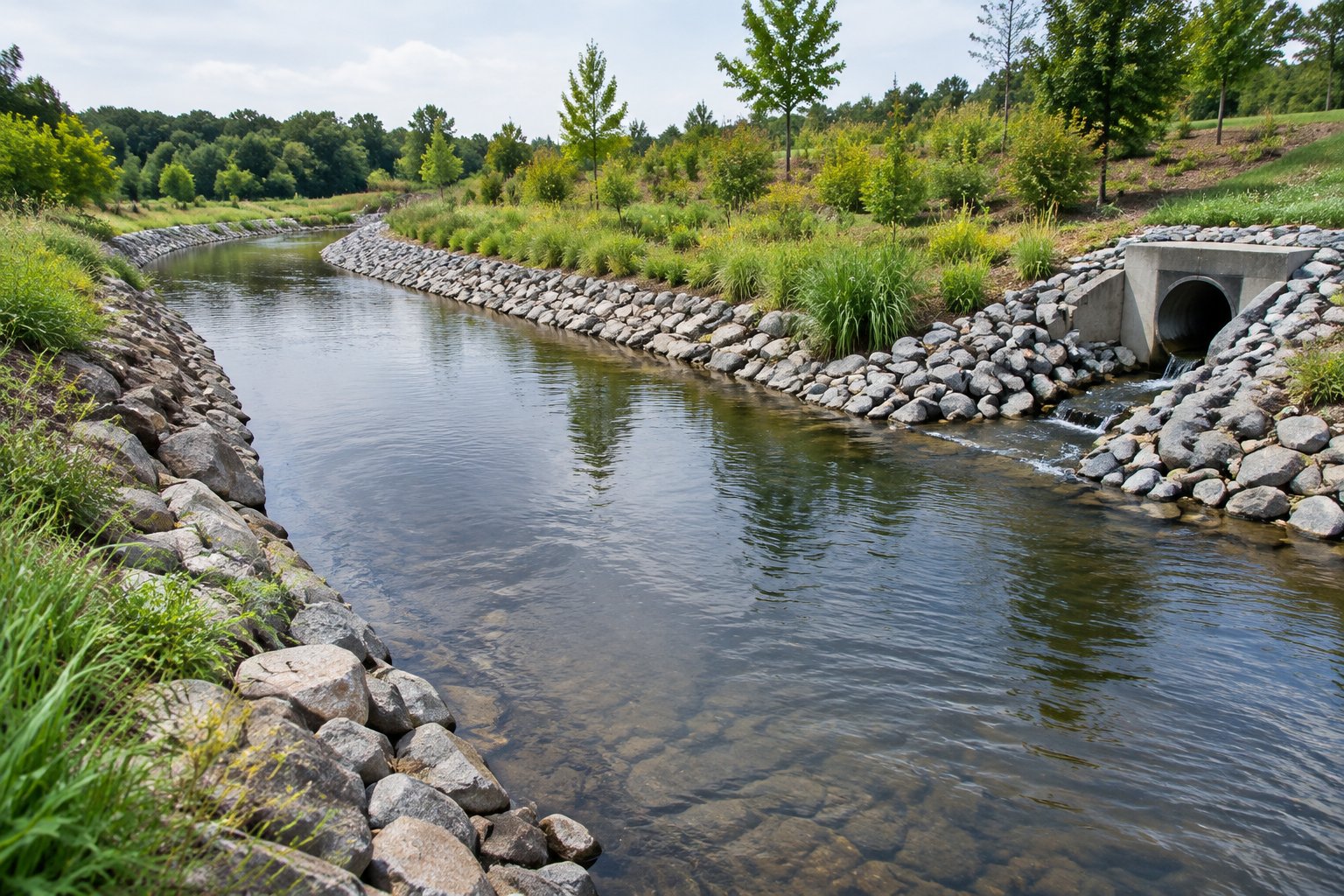
Some locations exceed what any biodegradable blanket can do. Drainage channels, spillways, culvert outfalls, dikes, levees, and riverbanks see concentrated flow at velocities that strip organic fiber.
TxDOT guidance on channel liners and soil retention blankets notes that organic and composite linings serve vegetation establishment and offer no long-term channel protection, while synthetic materials are preferred in ditches with frequent flows deeper than 8 inches.
For those conditions, plan on a turf reinforcement mat or an engineered channel lining. Our approach to erosion control in drainage channels starts with flow assessment, not product selection.
Match Blanket Materials to Service Life and Vegetation Goals
Material choice follows service life. Ask how many months the blanket must function before vegetation takes over, then pick the fiber that lasts that long.
When a Straw Blanket Fits Temporary Stabilization
A straw blanket or straw mat is the workhorse for short-term cover on moderate slopes. Straw products typically break down within about one growing season, depending on the product and conditions, which can suit seed mixes that establish quickly. Warm-season grasses often begin germinating within 7 to 14 days when temperature and moisture are favorable.
A straw product rated for the site's gradient, slope length, and flow can work well behind hydroseeding on slopes with sheet flow. It costs less per square foot than coconut products and installs quickly across large areas.
Where it falls short: steep grades with long slope lengths, winter installations that sit exposed for months, and sites with concentrated runoff.
Where Jute and Burlap Fit Biodegradable Erosion Control
Jute erosion control blankets and jute netting are open-weave products made from jute fibers. They allow seed contact and light shading, and they decompose fully.
Jute mesh and burlap netting are used for light slope work, seeded areas needing modest surface hold, and sites where full biodegradability is required. The open weave gives less soil coverage than a fiber blanket, so rill protection is limited.
On Texas jobs with wildlife or environmental documentation requirements, natural fiber products help. Texas Parks and Wildlife guidance recommends wildlife-friendly erosion control blankets that use no netting or loosely woven natural fiber netting, and advises avoiding plastic netting.
When a Coir Erosion Control Blanket Supports Longer Establishment
Coir mats, coir blankets, and coconut erosion control blankets last far longer than straw. Coconut fibers resist decomposition, so protection can extend through multiple seasons while deep roots form.
That service life makes a coir erosion control blanket worth considering, where its tested performance fits the site, for:
- Steep slopes where establishment takes months
- Native grass seeding, where establishment can take several months
- Shaded slopes or north-facing cuts with slow germination
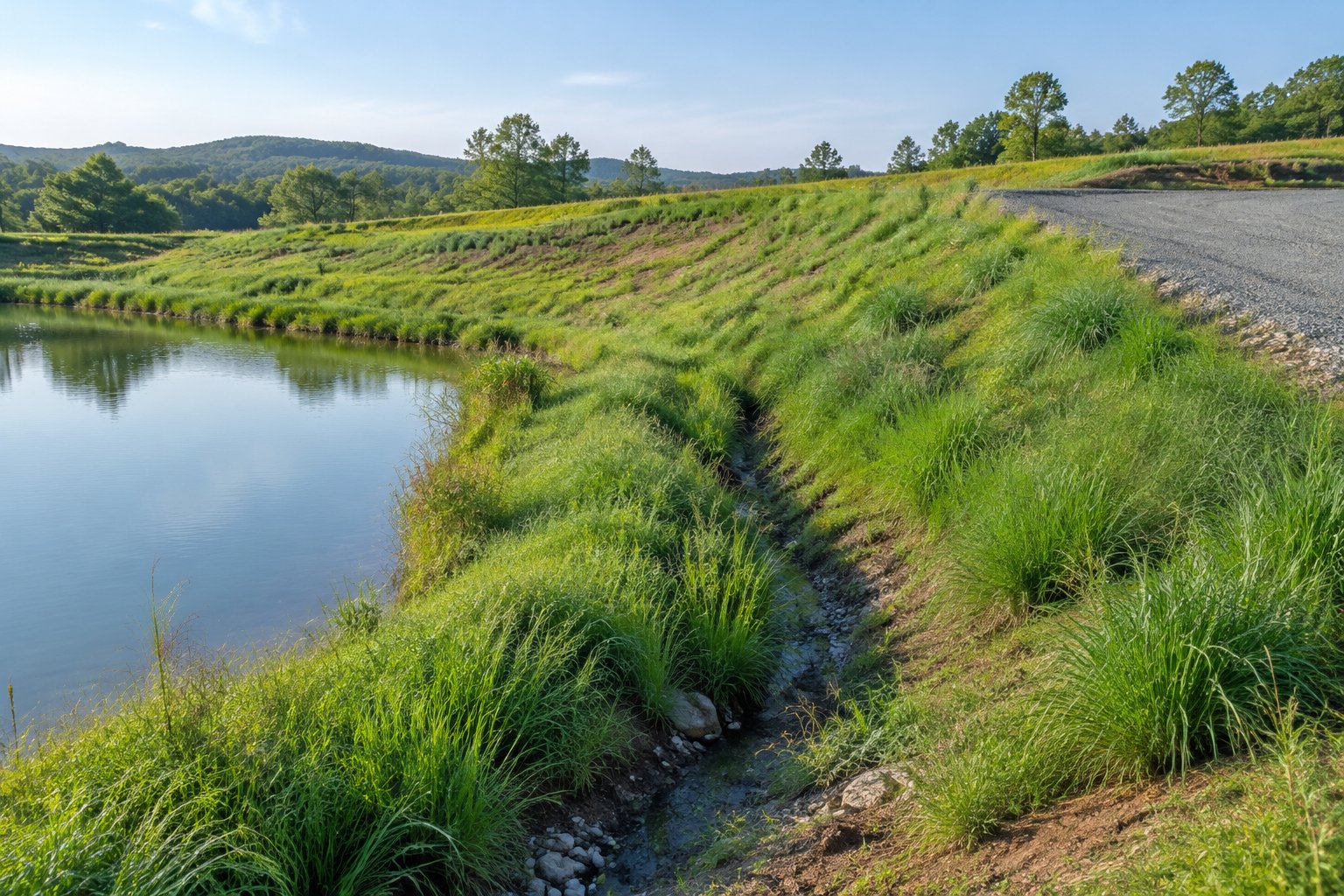
- Pond banks, swale sides, and low-velocity channel shoulders
- Reclamation sites where re-entry for repairs is difficult
Coconut fiber blankets cost more per roll. On a steep slope that would otherwise need a second application, the math often favors the longer-lasting product.
When Turf Reinforcement Mats Are Required
Turf reinforcement mats (TRMs) are permanent products. The synthetic matrix stays in place and interlocks with the root mass to carry hydraulic stress long after a biodegradable blanket would be gone.
Specify a TRM where design flow exceeds what vegetation alone can resist: channel bottoms, spillway aprons, steep slopes with concentrated discharge, and streambank work. NRCS classifies TRMs separately from blankets for exactly this reason.
If the project calls for a high-performance hydraulic option on steep, disturbed soil, Flexterra erosion control installation is another route we use where blanket placement is impractical.
Compare Blanket Construction and Specification Requirements
Construction details separate products that look similar on a cut sheet. Netting count, netting type, fiber weight, and manufacturer test data all affect field performance.
Single Netting vs. Double Netting
Single-net blankets have netting on the top face only. They cost less, lay flat easily, and suit flatter slopes with sheet flow.
Double netting sandwiches the fiber between two layers. That construction holds fiber in place on steeper grades and resists tearing during installation and heavy rain.
Double-net construction is common on steeper grades, but the product's tested limits and the project specification, not a slope threshold alone, decide whether single or double net is acceptable. Common spec designations run from S100 single-net straw through S200 double-net straw, SC200 straw-coconut, and C200 coconut double net.
Biodegradable Netting vs. Photodegradable Netting
Biodegradable netting breaks down through microbial action and leaves nothing behind. Photodegradable netting relies on sunlight exposure and can persist where it stays covered by soil or vegetation.
Texas transportation guidance on vegetation resources states that where soil retention or erosion control blankets are used, efforts should be made to furnish only spray-on products or blankets free of UV degradable, photodegradable, or polypropylene materials, with products made of natural woven fibers.
Check the specification before ordering. Netting type is the detail most often missed at the submittal stage.
How Moisture Retention Supports Seed Germination
Blankets hold moisture at the soil surface, which shortens the window between watering events and germination. On south-facing Texas slopes in July, that buffer decides whether the seed mix survives.
Fiber density controls the effect. Denser mats retain more water and shade the surface, which supports seed establishment for native vegetation with slower germination.
Balance matters on clay. Too much retained water on a compacted clay slope creates surface saturation, which weakens the soil bond under the blanket.
What to Confirm in Project Specifications and Manufacturer Data
Pull the numbers before you buy. Items worth confirming on every steep slope job:
- Approved product listing for the owner or agency, including TxDOT's approved materials list
- Maximum slope gradient and permissible shear stress from the manufacturer
- Fiber type, fiber weight, and netting configuration
- Functional longevity in months
- Required staple or stake pattern and quantity per square yard
- Seed mix compatibility and any regional ecotype requirement
TxDOT publishes performance data for rolled and spray-on erosion control products through field testing at the Texas Transportation Institute Sediment and Erosion Control Laboratory, with results posted on its erosion control products and vendors page.
Installation Details That Determine Field Performance
Installation quality decides whether the spec performs. Most blanket failures we see trace back to seedbed prep, anchoring, or seam treatment.
Prepare the Seedbed Before Placing the Erosion Control Roll
Grade the slope smooth. Every rut, clod, and footprint under an erosion control roll creates a void where water travels.
Loosen compacted surfaces so roots can penetrate. Apply seed, fertilizer, and soil amendments before the blanket goes down, then avoid tracking equipment across the seeded face.
Fill and compact any rills from earlier rain events. A blanket bridging over an existing rill channels water underneath it.
Use an Anchor Trench to Secure the Top of the Slope
Where the manufacturer's or project details call for it, cut an anchor trench at the crest, place the blanket end in the trench, staple it, then backfill and compact. Trench dimensions vary by product and detail; 6 inches is a common depth, but the specified detail governs. That anchoring keeps runoff from getting beneath the material.
Without proper anchoring at the top, sheet flow from above lifts the upper edge and peels the roll downslope. This is the single most common installation shortcut on steep grades.
Use biodegradable stakes where the spec or owner requires full breakdown. Follow the manufacturer's and project's staple pattern rather than a crew's habit. Many details call for denser stapling on steeper slopes, but the required density comes from those details, not a rule of thumb.
Secure Seams, Overlaps, and Edges Against Runoff
On most slope installations, rolls run down the slope rather than across it, but follow the orientation shown in the manufacturer's and project details. Overlap adjacent rolls by the manufacturer's dimension and shingle end-to-end laps so water flows over, not into, the joint.
Trench or staple the downslope terminal edge and both side edges where flow could undercut the blanket. Check seams after the first rain and re-staple where fiber has lifted.
Coordinate Blankets With Hydroseeding and Native Grass Seeding
Sequencing keeps the schedule intact. Seed first, place the blanket immediately after, then let germination proceed under cover.
Hydroseeding pairs well with blanket placement on steep grades: the slurry gives seed-to-soil contact and the blanket adds surface armor. For native grass seeding on commercial sites, where establishment can take several months, longer-life fiber matches the slower timeline of deep-rooted plants.
Some specs call for curled excelsior fiber blankets, where the barbed excelsior fibers interlock to hold the mat together. Confirm availability early, since lead time on specialty products can affect your stabilization date.
Match the Blanket to the Site, Then Protect the Schedule
There is no single best erosion control blanket for steep slopes, but there is a clear right answer per site. Define slope angle, runoff pattern, soil, and required service life, then select the lightest product whose tested performance covers those conditions and the project specification.
Short-lived straw products often cover temporary work on moderate grades. Longer-lasting coir and coconut erosion control blankets are often chosen for steep faces and slow-establishing native seedings, where their tested performance fits. Turf reinforcement mats are permanent products for areas where vegetation alone cannot resist the design flow. Correct anchoring, following the manufacturer's and project details, turns any of those specs into surface protection that holds through a Gulf Coast storm season.
We have been installing erosion control blankets and hydraulic products across Texas, Louisiana, Oklahoma, and New Mexico since April 1990, and we mulched approximately 15 million square feet in 2025 for more than 60 unique clients. If you have a slope spec in hand or a bare cut that needs cover before the next inspection, send us the grades, slope lengths, and soil conditions, or call 281-482-8212 to request a project quote for the blanket work. If part of the site only needs standard hydroseeding, Allied's calculator gives a rough estimate from the project size in square feet.
Frequently Asked Questions
What Is the Best Erosion Control Blanket for Steep Slopes?
The right blanket depends on the specific product's tested performance, slope gradient and length, expected flow, soil, and how long protection must last, not on fiber type alone. Straw-coconut and coir blankets are common on steep Texas slopes, and coir lasts longest. Confirm the product against the manufacturer's data, the project specification, and the owner's approved materials list before ordering.
What Type of Erosion Blanket Works on a 1H:1V Slope?
There is no single answer by slope ratio. On a slope that steep, choose a product whose manufacturer data covers the gradient, slope length, and expected flow, and confirm with the project engineer that the slope itself is stable, since a blanket provides surface erosion protection, not structural support. Long-lasting coir or straw-coconut products with double netting are common candidates. Follow the manufacturer's and project's anchoring and staple details.
When Should a Contractor Use a Coir Erosion Control Blanket Instead of a Straw Blanket?
Consider coir when protection must last beyond one growing season or when a straw product's tested limits do not cover the slope and flow. Native grass seeding, shaded cuts, and pond banks often fit that profile, since establishment can take several months. Straw remains a cost-effective option on moderate grades with fast-germinating seed when its tested performance fits the site.
How Can I Prevent Soil Erosion on a Steep Construction Slope?
Get seed and cover on the surface as soon as grading finishes, then control the water arriving from above. A blanket or hydraulic mulch protects the soil while vegetation establishes, and stormwater compliance erosion control measures divert concentrated flow away from the face. Inspect after each rain and repair rills right away.
Do Erosion Control Blankets Need an Anchor Trench?
Most steep slope installation details include an anchor trench or equivalent anchoring at the top of the slope. Placing the blanket end in the trench, stapling, then backfilling prevents runoff from flowing underneath. Trench dimensions and anchoring methods vary by product, so follow the manufacturer's and project details. Poor top anchoring is one of the most frequent causes of blanket failure we encounter.
When Is a Turf Reinforcement Mat Needed Instead of a Biodegradable Blanket?
Use a turf reinforcement mat where design flow will exceed what vegetation can resist on its own, such as channel bottoms and spillway aprons. Organic linings support vegetation establishment but provide no long-term channel protection. A biodegradable erosion control blanket remains appropriate for slope areas with sheet flow.