.svg)


A landfill cap that will not hold vegetation becomes a compliance problem fast. Rills form on the side slopes after the first heavy rain, sediment leaves the site, and the closure certification stalls while corrective work gets priced and scheduled.
For civil engineers and environmental project managers running a regulated closure, the vegetative cover requirement is not a landscaping line item. It is the last gate between an active permit and post-closure care.
Landfill hydroseeding solves a narrow set of hard problems: thin cover soil, low fertility, compaction from cap construction equipment, and 3:1 or steeper side slopes that shed water before seed can establish. The method places seed, mulch, fertilizer, and soil conditioners in a single hydraulic pass.
That matters when the closure schedule leaves a short window between final grading and the first inspection.
In this guide, you will find how cap surfaces differ from ordinary construction soils, how daily cover differs from final cover vegetation, how seed mixes are specified to protect liner integrity, and when hydraulic application beats drill seeding. By the end,d you should be able to scope your closure vegetation work with realistic timelines and defensible documentation.
Why Landfill Caps Need a Different Vegetation Plan
A landfill cap is an engineered structure, not a growing medium. The vegetation plan has to protect that structure while surviving conditions that would kill an ordinary seedling.
Cap surfaces are built to shed water and resist penetration. Everything that makes a cap perform well as a barrier works against seed germination. That tension drives every decision on these sites.
Compacted Soils, Low Fertility, and Surface Runoff
Cover soil on a closed cell is usually placed and compacted in lifts, then graded to a fixed slope. The result is dense, low-organic material with almost no seed bank and poor water infiltration. Rain runs off instead of soaking in.
Hydraulic application helps because the slurry sits on the surface as a moisture-holding blanket. Seeds stay in contact with the soil instead of washing to the toe of the slope. Fertilizer and soil conditioners go down in the same pass, which matters when the cover soil tests low in nitrogen and organic matter.
Bare cap surfaces also generate dust during dry stretches, which becomes its own nuisance complaint. Getting a cover crop and permanent seed established early reduces both airborne dust and sediment loss.
Steep Side Slopes and Cap Erosion Exposure
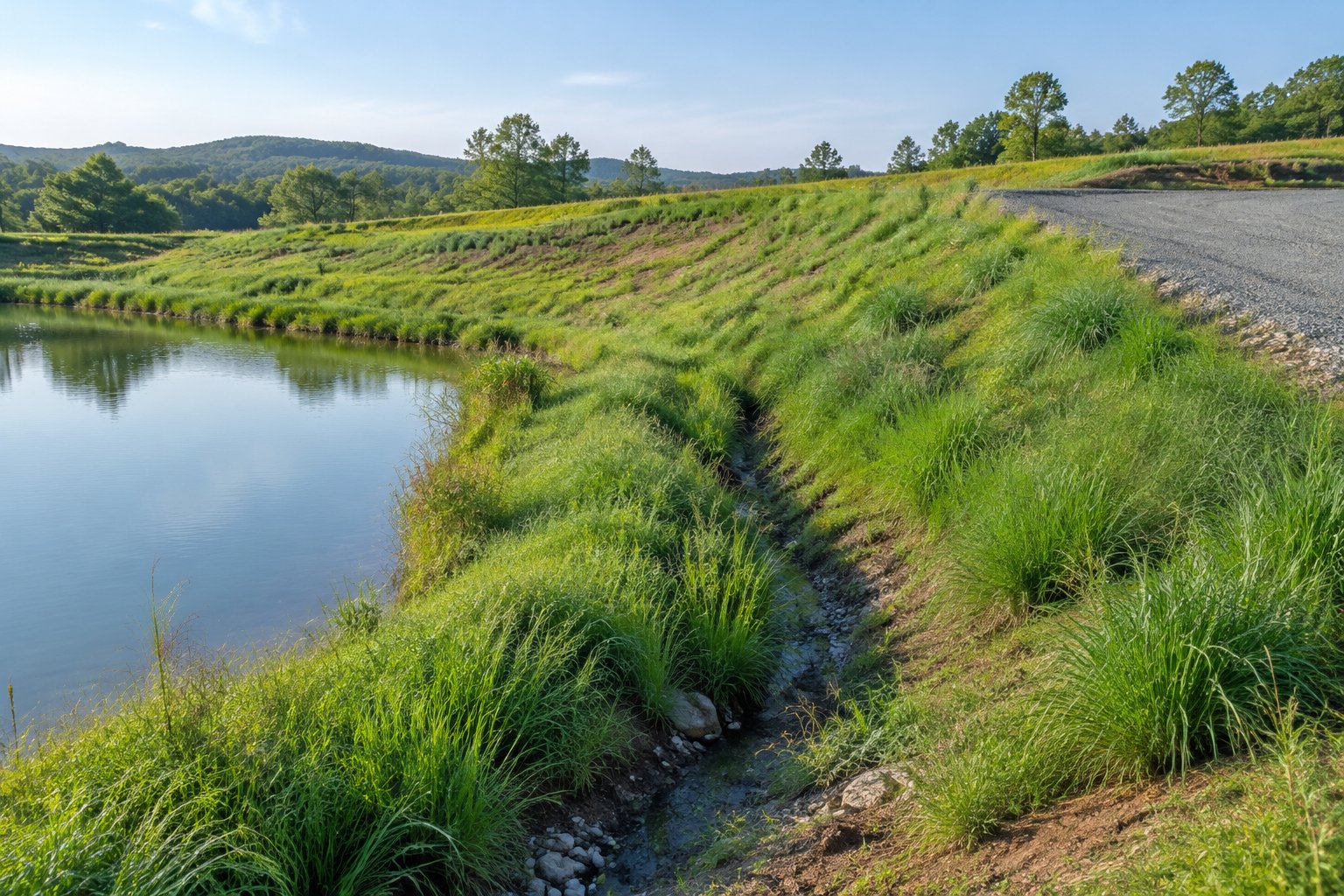
Side slopes carry the highest risk on any closure. Long, uninterrupted slope lengths at 3:1 or 4:1 concentrate flow and cut rills before roots can hold the surface.
On those faces, standard hydraulic mulch may not be enough. Bonded fiber matrix products and flexible growth media such as Flexterra hold the surface through rain events while seeds germinate. We select the product based on slope grade, slope length, and how soon the site expects rainfall.
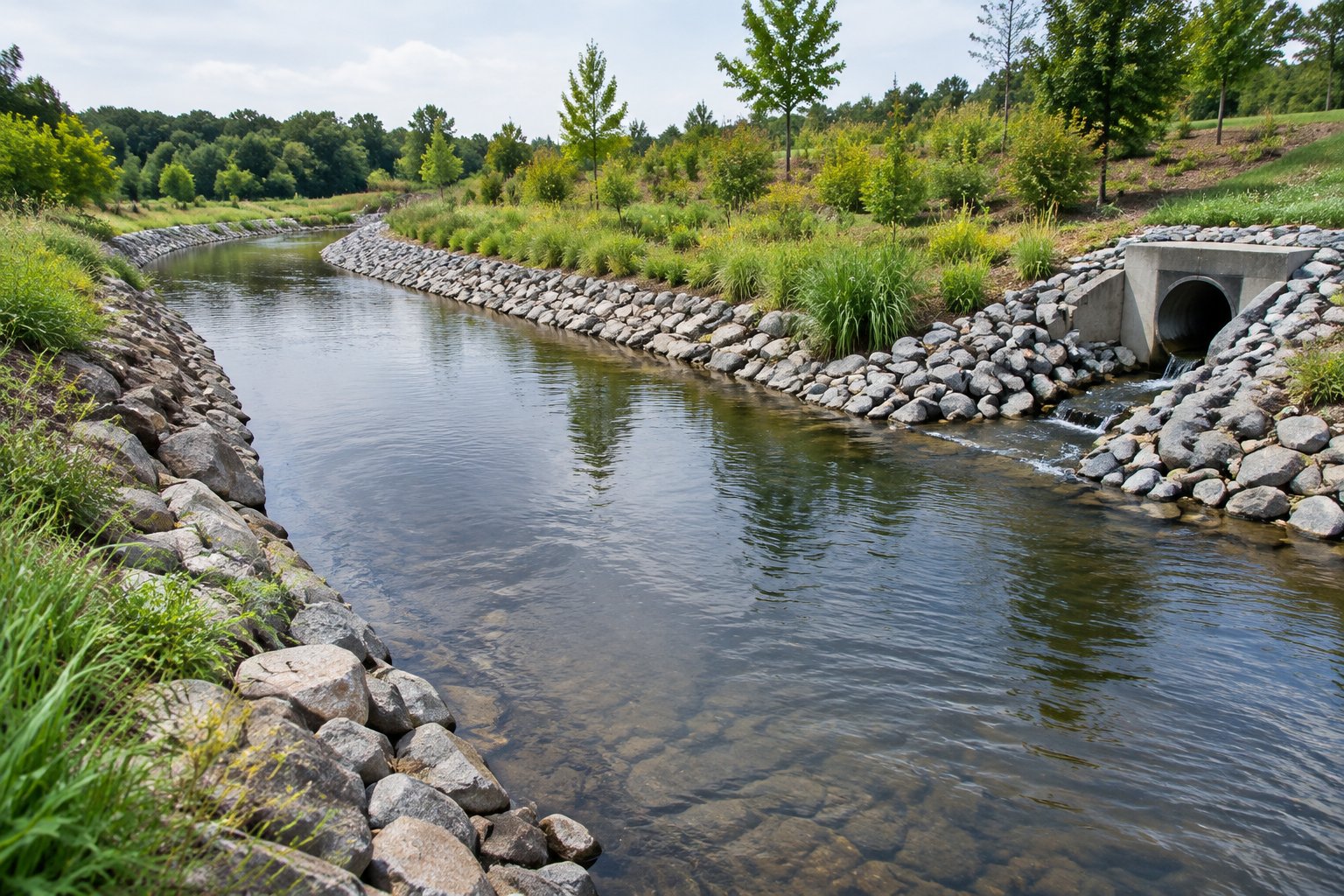
Where flow concentrates at benches or letdown structures, erosion blankets or channel protection often pair with the seeding. Those transitions are where inspectors look first.
Methane Venting, Liner Protection, and Root Depth Limits
Cap systems include gas vents, geomembrane layers, and drainage media that cannot be disturbed. Deep taproots and woody volunteers are the long-term threat. Not the grass itself.
That is why closure specs favor fibrous-rooted grasses and exclude trees and deep-rooted shrubs. Root depth limits are written into most closure plans and post-closure care plans, and they shape the seed list before anyone talks about the application method. Federal rules for closure with waste in place treat cover integrity as a performance standard.
Anything that could puncture or dry out the barrier is a problem. Before the final cap is even seeded, though, most sites are still managing active waste areas with a very different cover strategy.
Separate Daily Cover From Final Cap Vegetation
Daily cover and final cover solve two different problems. Confusing them leads to scope gaps and wasted money. Daily cover controls odor, vectors, litter, and fire risk on working faces. The final cover establishes permanent vegetation that has to hold for decades of post-closure care.
How Landfill Alternative Daily Cover Serves Active Waste Areas
Alternative daily cover (ADC) replaces six inches of soil at the end of each operating day on municipal landfills. It saves airspace and reduces soil hauling. ADC is temporary by design and is removed, buried, or covered the next working day again.
Nothing about ADC is meant to grow. It is a short-duration barrier over solid waste, applied and reapplied continuously as the cell fills.
Contractors sometimes get asked to hydroseed intermediate cover on cells that will sit idle for months. That is a legitimate application. But it is temporary stabilization, not closure vegetation.
Why Final Cover Requires Long-Term Vegetation Establishment
The final cover is where the vegetation specification lives. The cap has to reach a defined percent vegetative cover, hold that cover through wet and dry cycles, and require minimal maintenance during post-closure care.
That means a permanent seed mix, not a quick annual. Native grass seeding typically germinates in two to four weeks and establishes over two to three months. This has to be built into the closure schedule rather than discovered late.
Long-term performance also means low mowing demand. Fewer equipment passes on a cap mean less risk to gas vents and less surface disturbance.
Common Alternative Daily Cover Materials and Their Limits
ADC materials vary by permit and region. Each has trade-offs worth knowing before you assume one will help with final stabilization:
- Spray-applied foam products: fast coverage, but consumed daily and have no vegetative value
- Synthetic blankets or tarps: reusable, labor-intensive to deploy and retrieve
- Compost and green materials: useful organic matter, subject to approval and availability limits
- Shredded tires and auto-shredder residue: approved in some permits, no growing function
- Processed construction waste: volume-efficient, not a substitute for cover soil
None of those materials establish vegetation. This is why the closure seed specification is a separate line item entirely.
Selecting Seed Mixes That Protect the Cap
Seed selection on a closure site is a liner-protection decision first and a vegetation decision second. The mix has to cover the surface densely without sending roots where they do not belong.
Most closure plans call for regionally adapted perennial grasses with fibrous root systems. Depth, density, and drought tolerance are all weighed together.
Native Grass Mixes for Low-Maintenance Closure Sites
Native grasses are the default on closed landfill sites because they survive without irrigation once established. Once a stand takes hold, it holds soil through summer heat and heavy rain without ongoing inputs.
Guidance from the NRCS conservation seeding process walks through how species attributes and seeding rates are combined into a working mix. Typical closure mixes in our market lean on bunch- and sod-forming warm-season species with a cool-season component for shoulder-season cover.
Purity, germination rate, and pure live seed values should all be verified against the spec before application. Our native grass seeding for commercial sites follows the same logic as reclamation and corridor projects.
Balancing Dense Vegetative Cover With Liner-Safe Root Systems
Density and root depth pull in opposite directions. You want fast canopy closure to stop raindrop impact, but shallow enough rooting to leave the barrier layer alone.
That balance is achieved through species choice and seeding rate rather than by adding more seed of one aggressive grass. Over-seeding a single species often produces a thin stand later when competition thins it out.
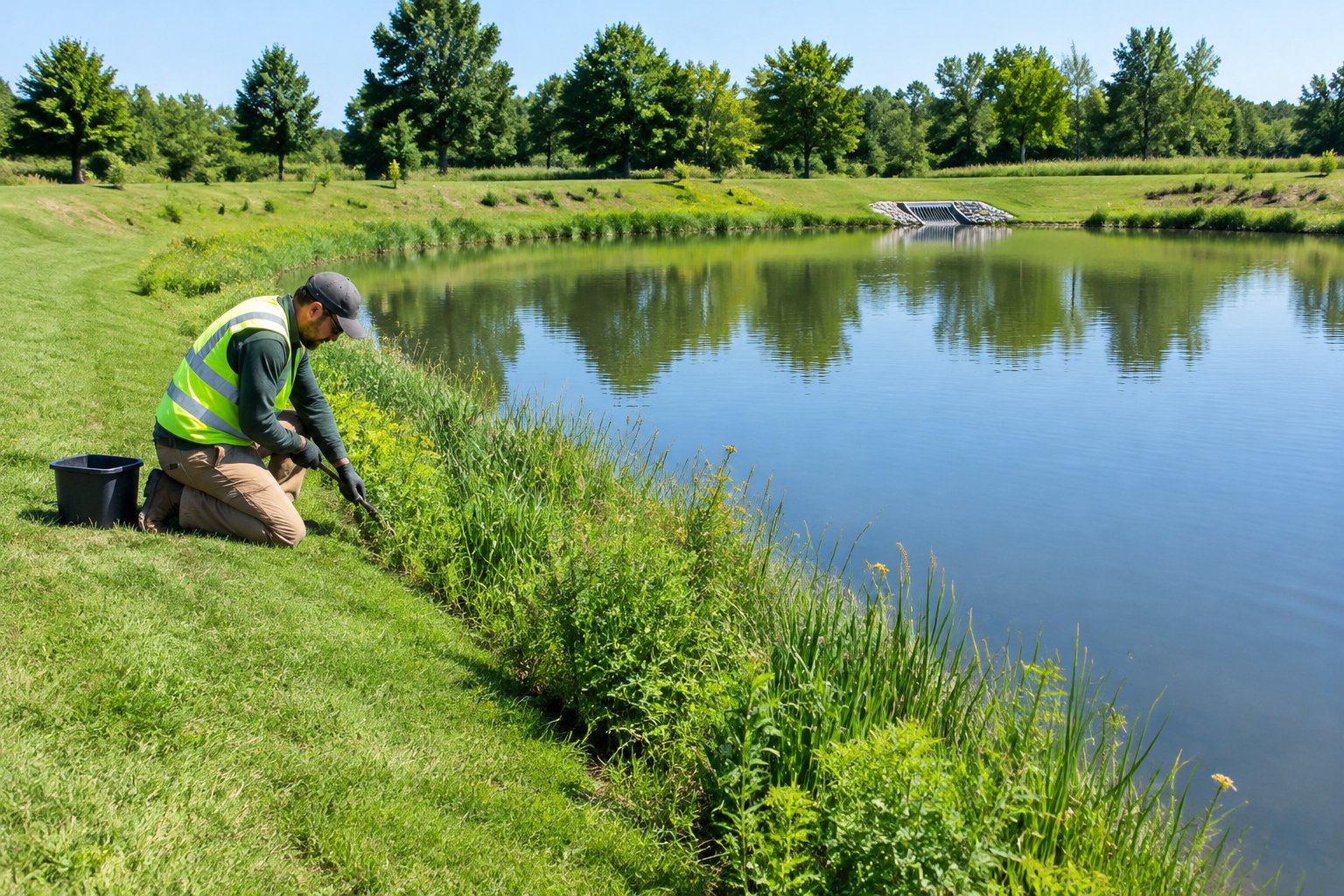
Volunteer woody species are another risk. Closure plans usually require periodic removal. A dense grass stand that resists tree establishment reduces long-term maintenance costs.
Matching Seed Specifications to Texas and Gulf South Conditions
Texas cap sites bring their own set of problems. Expansive clay in cover soil cracks in drought and seals over in heavy rain. Gulf Coast rainfall can drop several inches in a single event.
Seasonal timing matters as much as species. Warm-season mixes want soil temperature, not a calendar date. Mid-summer applications on an unirrigated cap carry real establishment risk.
Regional seed specifications, including TxDOT's seeding for erosion control items, are a useful reference point when a closure plan does not name a mix. With the mix settled, the next call is how that seed physically gets into the ground.
Choosing Hydraulic Application or Drill Seeding
Method selection comes down to slope grade, access, and soil condition. Hydraulic application covers what equipment cannot safely drive. Drill seeding wins where a tractor can operate.
Both methods appear on the same closure project, often on the same day. Deck areas and side slopes rarely call for the same approach.
When Hydroseeding and Hydromulch Fit Steep or Restricted Areas
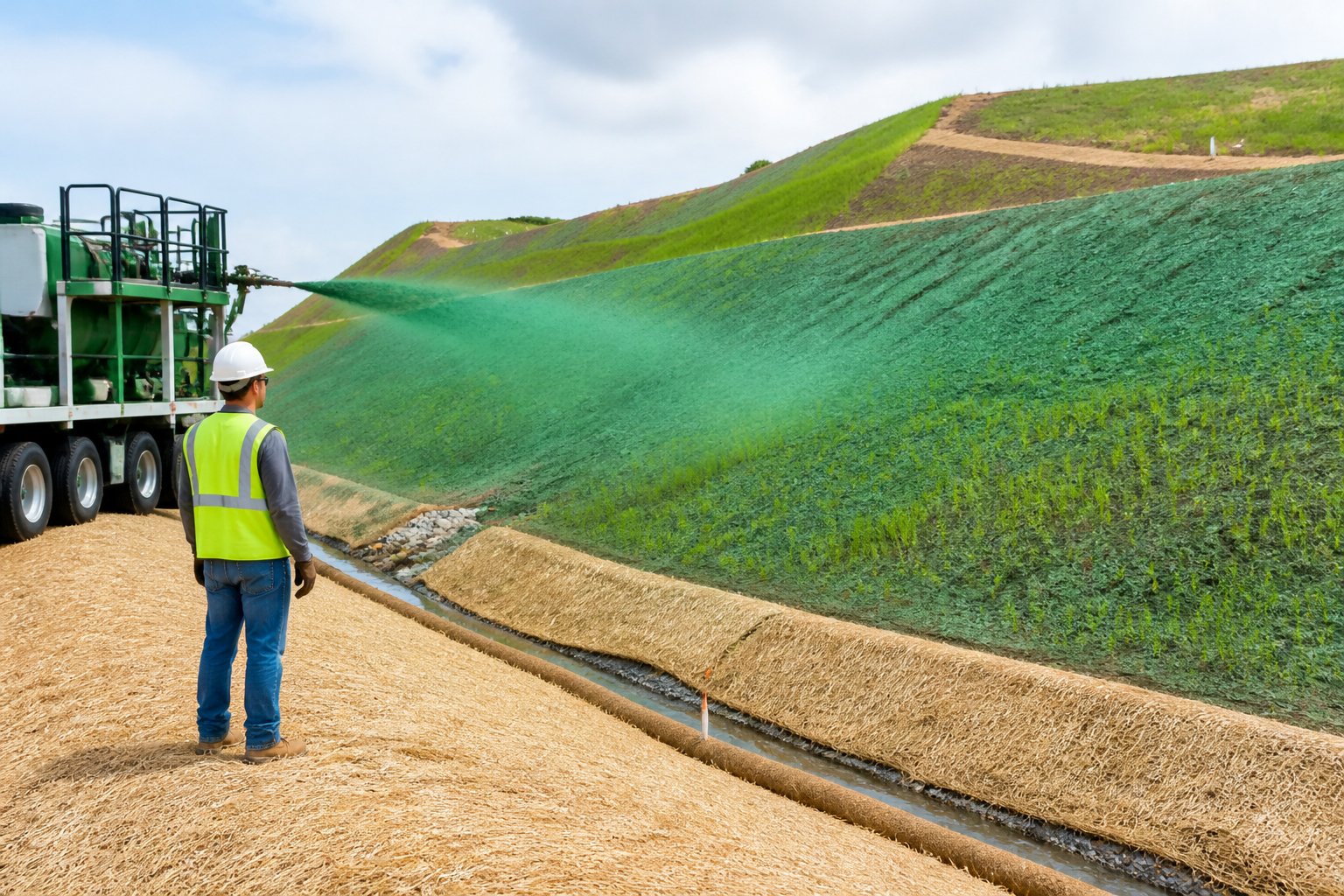
Hydroseeding is the practical choice on cap side slopes. A hydroseeder can shoot slurry from the toe or the crest without tracking equipment across the geomembrane or the gas collection system.
The slurry carries seed, mulch made from wood or fiber products, fertilizer, soil conditioners, and binding agents in one application. Germination typically begins within 7 to 14 days, with full establishment in 4 to 6 weeks,ks depending on weather and moisture.
Hydraulic mulch also protects the surface immediately. That first layer of cover matters on a cap that has just been graded and has no protection at all.
When Drill Seeding Provides Better Seed-to-Soil Contact
Drill seeding places seed at a consistent depth and spacing, which improves seed-to-soil contact and cuts seed waste. On flat cap decks and wide benches with good access, it produces a more uniform stand with germination typically in 1 to 3 weeks.
The limit is depth control. Drill equipment cannot be used where cover soil is thin over the barrier layer. Operators need to know exactly where vents and monitoring points sit. For large acreage where access allows, drill seeding is often the more efficient option per acre.
How Access, Slope Grade, and Soil Conditions Drive the Method
A few conditions usually decide the call on site:
- Slopes steeper than 3:1: hydraulic application with bonded fiber matrix or Flexterra
- Flat decks with equipment access: drill seeding for depth consistency
- Thin cover soil over barrier layers: hydraulic application only. No ground penetration.
- Areas around gas vents and monitoring wells: hand-guided hydraulic work
- Concentrated flow paths and letdowns: seeding plus erosion blankets
Once the method is set, the remaining risk is timing against the inspection calendar.
Meeting Vegetative Cover and Inspection Milestones
Closure approval usually hinges on a measured percent vegetative cover, not on whether seed was applied. The application date means little if the stand fails before inspection.
That makes cover thresholds and inspection dates the two numbers to plan backward from. Everything else, method, mix, and mobilization, follows those dates.
Confirming Permit-Specific Cover Thresholds Before Application
Thresholds vary by permit and by state program. Some closure plans state a percentage of uniform vegetative cover; others reference a performance standard tied to erosion and runoff.
Pull the actual language from the approved closure and post-closure care plan before pricing the work. Texas closure documentation requirements are outlined in the TCEQ guidance on closure and post-closure care plans. The specifics drive both seed rate and follow-up scope.
Knowing the threshold up front also tells you whether one application is realistic or whether a second pass should be carried in the budget.
Planning for Germination, Establishment, and Corrective Work
Build the schedule around establishment, not application. Native mixes need two to three months to establish, so a spec that requires measured cover leaves little room for a late-season start.
Corrective work should be planned, not improvised. Thin areas, washouts, and vent surrounds need spot reseeding commonly. Pricing that in advance prevents a scramble ahead of the inspection.
Rainfall works both ways in Texas. A wet spring helps germination; a five-inch event on an unprotected slope can erase two weeks of progress.
Documenting Erosion Control Performance for Closure Approval
Documentation carries as much weight as the stand itself. Application records, seed tags, product data, dates, acreage, and photos of pre- and post-application conditions all support the closure file.
Erosion control performance during rain events is worth documenting too. Photos after a significant storm showing an intact surface answer questions before an inspector asks them. Our approach to erosion control compliance documentation follows the same practice on construction and industrial sites.
With cover thresholds and documentation defined, the remaining variable is where seeding falls in the overall closure sequence.
Plan Cap Establishment Around the Closure Schedule
Seeding should be scheduled the moment final grading has a firm date, not after. Late mobilization is the most common reason closure vegetation misses its window. Cap work moves in sequence: cover soil placement, grading, drainage features, then vegetation. Vegetation is last. This means it absorbs every upstream delay.
Coordinate Seeding With Final Grading and Seasonal Conditions
Fresh grade is the best seedbed a cap will ever have. Waiting weeks after grading lets the surface crust. Clay-heavy cover soil in Texas seals over quickly under heat. Soil temperature drives germination more than the calendar. Warm-season mixes want warm soil.
A cold snap after a late-fall application can hold seed dormant into the following spring. Coordinate with the earthwork contractor so seeding follows grading within days, not weeks. That single scheduling detail changes establishment odds more than almost anything else.
Address High-Risk Slopes Before Inspection Deadlines
Treat side slopes first. They carry the highest erosion risk, the longest establishment timeline, and the most inspector attention.
On steep faces with a near-term deadline, pairing seed with a high-performance flexible growth medium buys protection while the stand develops. Slope-focused work like our bonded fiber matrix for slope stabilization applications handles the same conditions on cut slopes and embankments.
Flat deck areas can follow. They erode more slowly and tolerate a slightly later application without the same risk.
Request a Site-Specific Estimate for Closure Vegetation Work
Closure pricing depends on acreage, slope grade, access, seed spec, and whether a bonded product or blanket is required. Those variables move the number substantially, so a site-specific scope beats a per-acre assumption.
Useful information to have ready when scoping the work:
- Total cap acreage split by deck and side slope
- Slope grades and maximum slope lengths
- Approved seed mix and application rate from the closure plan
- Required percent vegetative cover and inspection date
- Access routes and any equipment restrictions on the cap
- Locations of gas vents, monitoring wells, and drainage structures
An online cost estimator gives a rough range for budgeting. A site walk tightens it into a scope you can hold a subcontractor to.
Keeping the Cap Stable Until the File Closes
Cap vegetation is compliance infrastructure. A dense, shallow-rooted stand established on schedule protects the barrier, controls sediment, and clears the last checkpoint before post-closure care begins.
The projects that go smoothly are the ones where seeding was scheduled alongside final grading, the mix matched the closure plan, and the method fit the slope. Allied Hydromulch TX, LLC has been installing hydroseeding, native grass seeding, drill seeding, and erosion control across Texas, Louisiana, Oklahoma, and New Mexico since 1990. This includes roughly 15 million square feet of mulch in 2025 alone.
If a closure inspection is on your calendar, get the vegetation scope priced early. Call 281-482-8212 or request a project estimate, and we will talk through slope grades, seed specs, and timing for your site.
Frequently Asked Questions
What Is Hydroseeding Used for on Landfill Caps and Closed Landfill Sites?
Hydroseeding establishes permanent vegetative cover on final cap surfaces so a site can meet its closure requirements. The slurry of seed, mulch, fertilizer, and soil conditioners protects freshly graded cover soil while grass germinates. It is used on both deck areas and side slopes where equipment access is limited.
How Does Hydroseeding Help Control Erosion on Landfill Slopes?
The hydraulic mulch layer shields the surface from raindrop impact and slows sheet flow immediately after application. That protection holds the cap together during the weeks before roots take over. On steeper faces, bonded fiber matrix or Flexterra adds surface strength through heavy rain events.
What Seed Mix Works Best for a Landfill Cover in Texas?
Most Texas closure plans specify regionally adapted native perennial grasses with fibrous, shallow root systems. Those mixes hold soil, tolerate clay cover soil and summer heat, and avoid rooting deep enough to threaten the barrier layer. Always match the mix to the language in the approved closure plan.
How Much Does Landfill Hydroseeding Cost per Acre?
Cost depends on acreage, slope grade, seed specification, access, and whether a premium bonded product or erosion blanket is required. Steep side slopes with a high-performance growth medium have a higher price than flat deck areas. An online estimator gives a budget range. A site walk produces a firm number.
When Is the Best Time to Hydroseed a Landfill Cap?
Soil temperature matters more than the calendar. Spring and early fall generally give the best germination in Texas and the Gulf South, with germination typically beginning within 7 to 14 days under good moisture. Mid-summer applications on an unirrigated cap carry higher establishment risk.
What Site Preparation Is Required Before Hydroseeding a Landfill Slope?
Cover soil should be placed, graded to the design slope, and left with a surface that seed can bind to rather than a sealed crust. Drainage features, benches, and letdowns should be complete before seeding. Gas vents, monitoring wells, and any thin-cover areas need to be flagged before crews mobilize.