.svg)


Planning Commercial Site Establishment
Bare soil on a Corpus Christi industrial pad does not stay put. Onshore wind, sandy coastal soils, and fast-moving Gulf storms move sediment off site before a stand of grass can hold it. That is the core planning problem on port, refinery, and highway work in Nueces and San Patricio Counties.
For most large commercial and infrastructure sites along the coast, hydroseeding in Corpus Christi is often the right method when you need vegetative cover across wide, flat to moderately sloped disturbed areas. With favorable temperatures and moisture, germination often starts in 7 to 14 days, and a usable cover can develop in 4 to 6 weeks. Steeper slopes, channels, and high-flow areas may call for a bonded product or blanket, depending on the product's tested performance and the specification.
What changes the plan on the coast is timing and exposure. Soil temperature, salt-laden wind, and the stabilization clock in your stormwater permit all shape when the tank gets loaded and what goes in it.
Is Hydroseeding the Right Fit for Your Corpus Christi Site?
Hydroseeding fits when you have large disturbed acreage, reasonable grades, and a need to get cover down fast. Professional hydroseeding can put a slurry of seed, mulch, fertilizer, and soil conditioners across prepared soil in one pass, which is far cheaper than sod across a multi-acre pad.
Where Hydraulic Application Supports Industrial and Infrastructure Projects
Coastal industrial work in the Corpus Christi area tends to produce wide, open areas of disturbed ground. That profile suits hydraulic seed application well.
- Liquefied natural gas (LNG) and petrochemical plant perimeters and laydown yards
- Port and terminal expansion areas after final grading
- Highway embankments, medians, and interchange slopes on Texas Department of Transportation (TxDOT) work
- Utility corridors, substations, and pipeline right-of-way restoration
- Commercial pads, distribution developments, and detention basin surrounds
Allied's project experience includes the Bechtel LNG project in Corpus Christi.
When Hydromulching Corpus Christi Sites Need Added Erosion Protection
Standard hydraulic mulch has limits. On a steep embankment or a freshly cut ditch bank, a product that is not rated for the conditions can move before roots take hold. Where that limit falls depends on the product's tested performance, soil conditions, slope length, expected flow, and the project specification, not a single slope ratio.
Those areas may need a bonded fiber matrix, a flexible growth medium, or an anchored blanket selected for those conditions. TxDOT guidance notes that as slope increases, the potential for sheet erosion rises, and that soil type plus slope drive temporary erosion control selection. Pairing hydroseeding with soil erosion control products gives you cover on day one while the grass fills in.
What Hydroseeding Can and Cannot Accomplish on Active Job Sites
Hydroseeding builds turf. It does not armor a channel or replace a sediment barrier at the perimeter.
Expect even coverage, moisture retention at the surface, and soil that stabilizes as roots develop. Do not expect instant protection against concentrated flow, or a stand that survives equipment traffic during the first month. Keep seeded areas out of the haul route.
How Coastal Exposure and Soil Conditions Affect Establishment
Coastal exposure pulls moisture out of the seedbed faster than inland sites. Wind, heat, and salt spray all work against early seed germination, so the water plan matters more here than it does 200 miles north.
Managing Heat, Wind, Rainfall, and Water Demand Near the Coast
Summer surface temperatures on bare soil can climb past 130 degrees Fahrenheit, which stresses seedlings before roots form. The mulch layer holds moisture at the surface and moderates that swing.
Two practical points for coastal scheduling:
- Timing depends on the seed. Warm-season permanent grasses such as seeded bermudagrass generally establish best when planted in late spring or early summer, according to Pennington's bermudagrass guidance, while September through November plantings are better suited to temporary cool-season cover
- Consistent moisture through the first two weeks after application is the single biggest driver of a successful stand
If no irrigation is available, rainfall has to carry establishment, but fresh slurry still needs its drying or curing window first. That window depends on the selected product and the weather, so check the product's requirements and avoid applying when heavy rain is forecast inside it.
Evaluating Soil Preparation, Compaction, and Drainage Before Application
Seed needs contact with loosened soil. Heavily compacted subgrade from months of truck traffic will shed water and stall root development, no matter how good the slurry is.
Grade the area, break up the surface crust, and clear debris before the crew arrives. County-level soil data from the USDA Natural Resources Conservation Service soil survey database gives texture and drainage information that helps set expectations before anyone mobilizes.
Planning for Slopes, Drainage Features, and Disturbed Soil
Map the site by zone before you write the scope. Flat pads, moderate side slopes, and channel bottoms each need a different product.
Retention ponds and swales carry concentrated flow, so they usually need lining or blanket treatment rather than hydraulic mulch alone. Our notes on hydroseeding retention pond slopes cover how permit timelines shape that call.
Selecting Seed Mixes for Corpus Christi Vegetation Goals
Seed mix selection follows the site's long-term use, not habit. A warehouse perimeter, a highway right-of-way, and a reclamation tract each want a different blend.
When Bermuda Grass Fits a Warm-Season Coverage Specification
Bermuda grass is the workhorse for warm-season coverage on coastal commercial sites. It tolerates heat, traffic, and drier soil, and LSU AgCenter describes it as a warm-season perennial that spreads quickly via stolons and rhizomes in full sun.
It is a poor choice under heavy shade or where a specification calls for native species. Common bermuda establishes from seed, which makes it practical for hydraulic application across large acreage.
Why Fescue and Tall Fescue Require Careful Site and Season Review
Fescue and tall fescue are cool-season grasses, and South Texas summers push them hard. Tall fescue does appear in Gulf Coast prairie plant communities, but as an introduced species, not a reliable long-term turf for an exposed coastal pad.
Review any fescue call-out against the actual planting season and irrigation plan. On most Corpus Christi projects, a warm-season base with a temporary cool-season cover crop performs better than fescue alone.
Using Native Grass, Wildflower, or Clover Mixes for Long-Term Site Objectives
Native grass seeding suits reclamation tracts, roadsides, and buffer areas where low maintenance is the goal. Germination often takes 2 to 4 weeks, and establishment can take several months.
TxDOT points out that native grasses put more effort into root development than top growth in year one, and a stand takes about three years to reach maturity, with roots that can extend several feet deep depending on species and soil. Wildflower and clover mixes add pollinator value on park and beautification work. Our guidance on native grass site restoration covers species selection in more detail.
How Custom Seed Blends Support Project Specifications
Custom seed blends let you meet a written spec without over-buying. A blend might pair a fast-germinating cover grass with a slower permanent species so the site has protection while the long-term stand develops.
Bring the specification sheet to the pre-bid conversation. Seed certifications and application records go into the stormwater file, so the mix has to match what the plan says.
Scheduling Application and Early Establishment Work
Schedule hydroseeding immediately after final grading, not weeks later. Every day of bare soil is exposure to a rain event and to an inspector's stabilization clock.
What Happens During a Hydroseeding Application
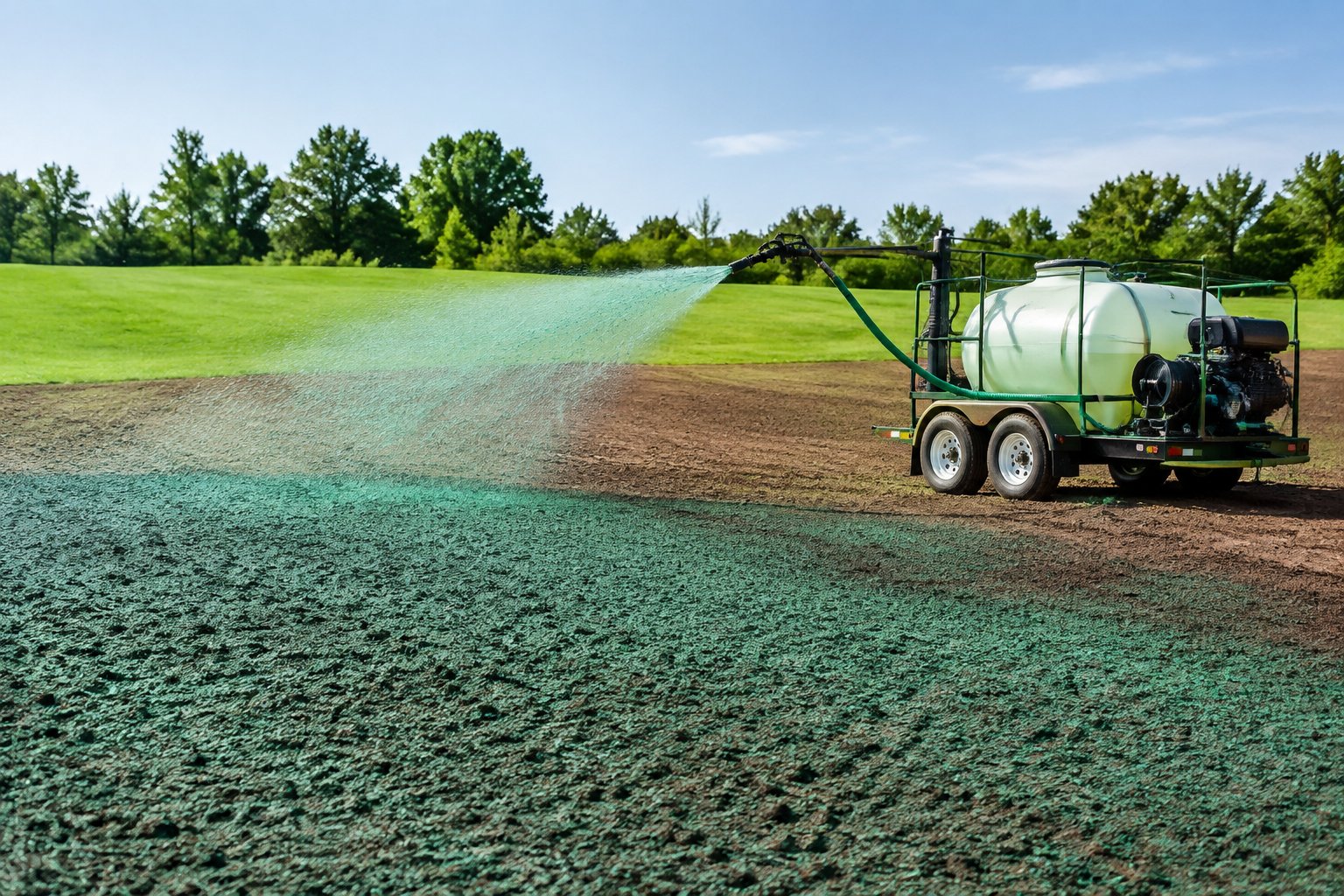
The crew mixes seed, hydraulic mulch, fertilizer, soil conditioners, and tackifier in the tank, then sprays it across prepared ground. Most applications finish in a single visit.
Coverage rates and tackifier ratios shift with slope and soil texture. On coastal sand, holding moisture is the priority; on clay, the mix needs conditioners to improve structure.
Typical Germination and Vegetation Establishment Timelines
Under favorable conditions, germination often begins within 7 to 14 days, and a usable cover can develop in 4 to 6 weeks depending on weather and irrigation. These are estimates; early growth is not the same as mature vegetation or final stabilization.
Drill seeding shows germination in roughly 1 to 3 weeks with strong seed-to-soil contact. Native mixes take longer, which is why closeout schedules should be built around the method actually specified. We break the sequence down further in our look at germination timelines in Texas.
How Irrigation and Rain Events Affect Early Growth
Steady light watering beats heavy soaking. Fresh slurry that gets hit by a two-inch downpour before it cures can channel and thin out on the high side of a slope.
Inspection frequency follows the applicable permit and your SWP3. The TCEQ Construction General Permit allows different inspection schedules, so confirm which one your SWP3 adopts and check seeded areas on that schedule. Fix thin spots early; a small touch-up pass costs far less than a full reapplication after a failed inspection.
When to Use Hydraulic Soil Stabilizers, Blankets, or Flexterra
Product selection follows the product's tested performance, soil conditions, expected flow, the specification, and how fast vegetation must take hold. As a general orientation:
- Standard hydraulic mulch: large flat to moderate areas with sheet flow
- Hydraulic soil stabilizer: areas where plain mulch would move, within the product's tested limits
- Flexterra: steep slopes and highly disturbed soils where its tested performance fits the site
- Erosion control blanket: swales, channel linings, and steep embankments with concentrated flow, as the design specifies
TxDOT distinguishes organic linings used for vegetation establishment from synthetics that work with the root matrix for long-term channel protection. Our write-up on Flexterra slope protection explains cure time and application rates.
Preparing a Clear Scope for a Corpus Christi Hydroseeding Proposal
A clear scope produces an accurate number and prevents change orders. Give the applicator site data, not just an acreage figure.
Site Details That Help Define the Right Application Method
Include these in the request for pricing:
- Total disturbed square footage, broken out by flat area and slope area
- Steepest slope ratio on site and where it occurs
- Soil type and whether topsoil was stripped or replaced
- Water source on site and whether irrigation is available
- Seed specification or the governing agency standard
- Target stabilization date and construction phase
Questions to Ask About Equipment, Materials, and Mobilization
Ask how fast a crew can mobilize, what mulch products are on the approved materials list, and how coverage gets documented. Ask whether the contractor can handle your acreage in one mobilization.
Cost varies with slope, access, seed spec, and scope, so a flat per-square-foot quote rarely survives contact with the site. Allied's calculator gives a starting estimate for standard hydroseeding from your project size in square feet; slope products and blankets need a project quote.
Coordinating Vegetation Work With Construction Phases and Compliance Needs
Texas construction sites disturbing one acre or more, including smaller disturbances within a larger common plan of development, fall under the Construction General Permit, and operators must develop a Stormwater Pollution Prevention Plan (SWP3) before construction begins, per the Texas Commission on Environmental Quality (TCEQ). Small construction sites (at least one acre but less than five) and large construction sites (five acres or more) have different filing requirements.
Sequence seeding to the grading schedule so exposed soil is stabilized inside the permit window. Our guide to erosion control compliance in Texas walks through inspection documentation.
Serving Corpus Christi, Portland, and Gulf Coast Project Areas
We work Corpus Christi, Portland, Ingleside, and the surrounding Coastal Bend, along with the wider Texas Gulf Coast. Crews also run projects in Louisiana, Oklahoma, and New Mexico.
Allied Hydromulch TX, LLC has been in business since April 1990 and mulched approximately 15 million square feet in 2025 for more than 60 unique clients.
Match the Vegetation Plan to the Site Conditions
Coastal projects reward planning that starts with the dirt. Soil texture, slope ratio, drainage pattern, and the local climate all decide whether a seed mix holds or washes into the bay after the first storm.
Hydroseeding covers the open acreage efficiently. Bonded products and blankets handle the steep and high-flow zones. Matching each zone to the right treatment, and sequencing the work to the grading schedule, is what keeps a site stabilized inside its permit window.
If you have a Corpus Christi project coming up, tell us the acreage, slope conditions, and target stabilization date. For standard hydroseeding, enter your project size in square feet in Allied's calculator for a rough estimate, then call 281-482-8212 to request a project quote and talk through the seed spec and erosion control products for your site.
Frequently Asked Questions
How Much Does Commercial Hydroseeding Cost in Corpus Christi?
Pricing depends on acreage, slope, seed specification, site access, and scope, so flat per-square-foot rates rarely hold up. Our online calculator gives a rough estimate for standard hydroseeding from your project size in square feet. Slope products, blankets, and other erosion control items need a project quote, so call 281-482-8212 with site details for a firm number.
How Long Does Hydroseed Take to Germinate in Corpus Christi?
Under favorable conditions, germination often begins within 7 to 14 days, and a usable cover can develop over 4 to 6 weeks. Coastal heat, wind, and irrigation availability all shift that window. Native grass mixes run longer, usually 2 to 4 weeks to germinate.
Will Heavy Rain Wash Away Hydroseed on a Gulf Coast Construction Site?
A hard rain shortly after application can thin coverage, especially on steeper slopes or where the product is not rated for the conditions. Bonded fiber matrix products generally resist rain better, but drying and curing times vary by product and weather. Scheduling the application so the selected product gets its required drying or curing window before heavy rain reduces the risk.
What Site Preparation Is Needed Before Hydroseeding?
Soil should be graded, loosened, and cleared of debris so seed makes good contact with the ground. Compacted subgrade sheds water and slows root development. Basic preparation improves germination rates and produces more even coverage.
How Late in the Year Can a Corpus Christi Project Be Hydroseeded?
It depends on the seed. Warm-season permanent grasses establish best when planted in late spring or early summer, and fall plantings of warm-season seed may not establish before cooler weather. September through November applications are better suited to temporary cool-season cover that holds the site until permanent seeding conditions return. Later winter applications are possible, but establishment slows considerably. Sites with a hard stabilization deadline in winter often pair seeding with a blanket or bonded product for immediate cover.
When Should a Project Use Erosion Control Products Instead of Hydroseeding Alone?
Use blankets, a bonded fiber matrix, or another rated product when a slope exceeds the tested limits of standard hydraulic mulch, when concentrated flow runs through swales or channels, or when soil is exposed to rain before grass can establish. Product choice should follow tested performance, soil conditions, expected flow, and the specification. Hydroseeding alone suits flat to moderate ground. Many sites use both, zone by zone.