.svg)


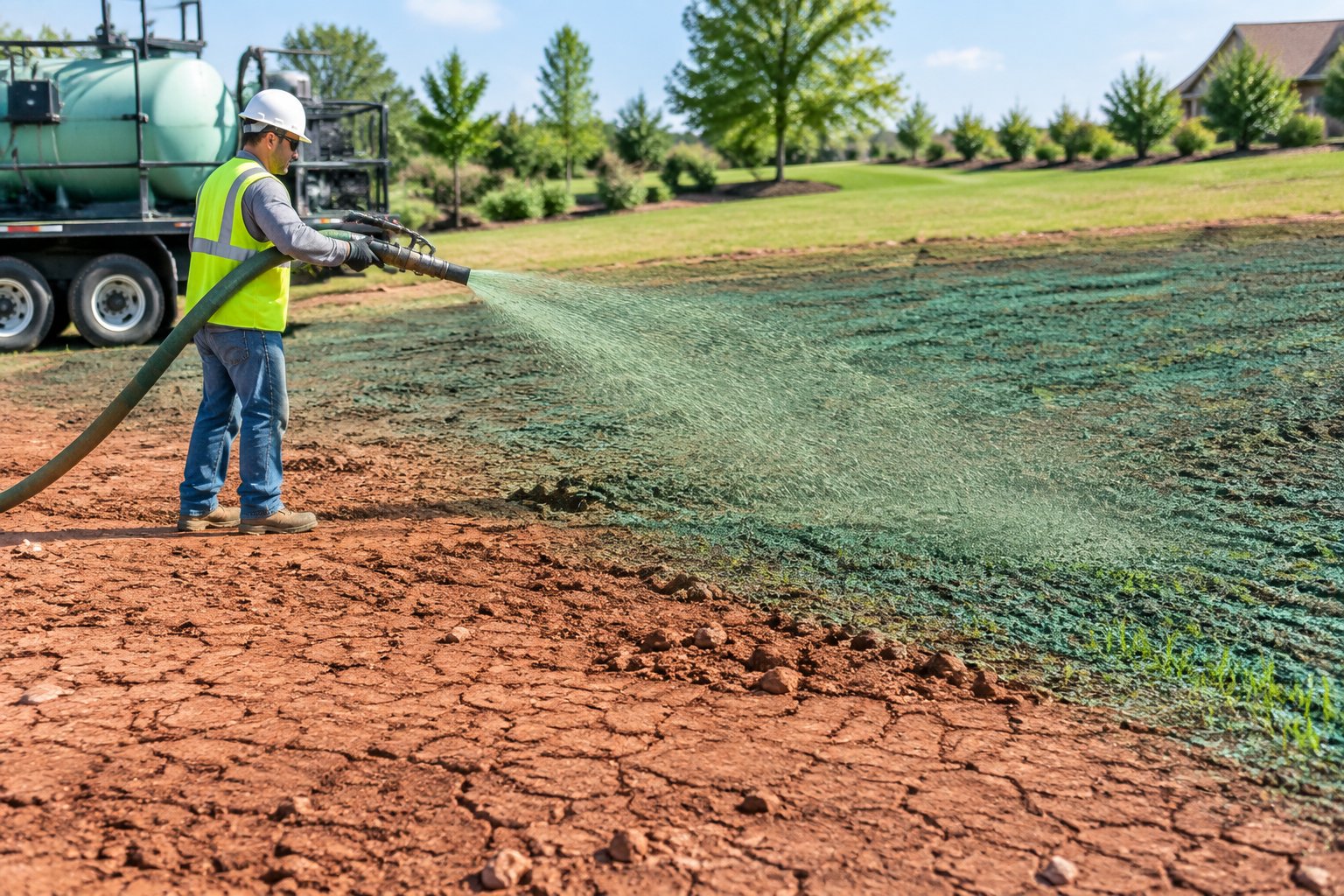
Bare clay on a commercial pad sheds water fast, crusts hard in the sun, and turns slick after a storm. Crews walk it and leave ruts. Inspectors see sediment leaving the site. Then someone asks whether seeding will even take.
Hydroseeding for clay soil works on Texas commercial sites when the ground is prepared first: compaction relieved, grades shaped for drainage, and seed matched to the soil. Clay itself is not the problem. Compacted clay with no topsoil, no surface texture, and no drainage plan is the problem, and that condition is fixable before the hydroseed slurry ever hits the ground.
Texas has more clay than most states deal with. Houston Black, the state soil, is a dark shrink-swell clay that Natural Resources Conservation Service (NRCS) soil scientists describe as sticky and moldable when wet, which is why locals call it black gumbo. Sites across the Gulf Coast, Dallas, and the Blackland corridor share that behavior: they hold water at the surface, resist root penetration when dense, and crack open in August heat.
What follows walks through the evaluation a contractor should run before requesting a seeding proposal, so the scope covers the site you actually have.
Does Hydroseeding Work on Clay Soil?
Yes. Hydroseeding performs well on clay soil when the seedbed is loosened and the site drains. The hydroseed mixture can place seed, mulch, fertilizer, and soil conditioners in one pass, and the mulch layer holds moisture at the surface while germination begins. On clay, that moisture-holding layer is an advantage, because clay crusts and bakes when it dries bare.
The failure cases share one trait: seed sitting on a hard, sealed surface with nowhere for roots to go.
Why Clay Creates Establishment Risks on Commercial Sites
Clay particles are extremely fine and pack tight under equipment traffic. TxDOT materials on soil treatment describe clay soils as moisture sensitive with expansion potential, poor workability, hard to compact properly, and prone to yielding when wet. Those same traits shape how vegetation behaves.
On a construction site, the specific risks look like this:
- Surface sealing. Rain beats the fine particles into a crust that seedlings struggle to push through.
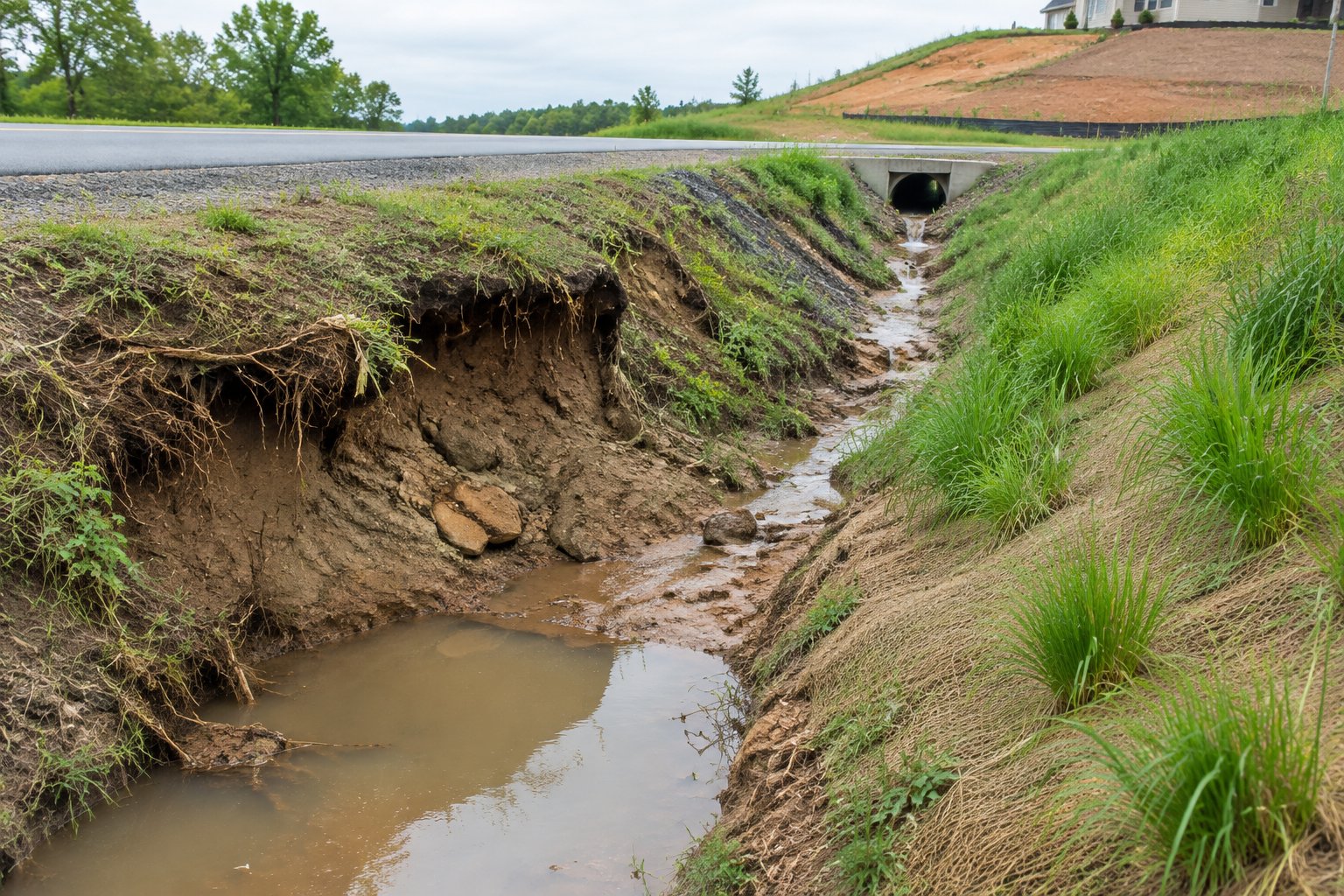
- Poor infiltration and drainage. Clay can hold plenty of water, but compacted or sealed clay takes it in slowly, so rain and irrigation sit on top, run off, or evaporate before reaching the root zone.
- Restricted rooting and poor aeration. Dense, compacted subsoil can confine roots to a shallow layer and starve them of air, which leaves the stand vulnerable in the first dry stretch.
- Runoff on slopes. Low infiltration means more sheet flow, and more sheet flow means more soil loss.
- Shrink and swell cracking. Clay pulls apart in drought and tears young roots.
When Hydraulic Application Is a Suitable Fit
Hydraulic application suits clay sites where the ground can be worked, the slope is moderate, and coverage is needed across large areas quickly. Commercial pads, detention basin side slopes at gentle grades, parking lot perimeters, and completed rough-graded acreage all qualify.
It also fits sites with uneven terrain where equipment access is limited. The slurry reaches ground a drill cannot cross. For large commercial sites needing fast vegetation, a single application covers acreage that would take days to sod.
When Erosion Control Measures Must Supplement Seeding
Seeding alone does not hold steep clay through a Gulf Coast rain event. Slopes steeper than about 3H:1V, concentrated flow paths, and channel bottoms need a stabilization product working alongside the seed.
TxDOT landscape guidance notes that mulches and compost suit gentle slopes of 4H:1V or flatter, and that temporary erosion control material becomes necessary as slopes increase, with soil type and slope driving product selection. On steep clay cuts and disturbed banks, a bonded fiber matrix or a flexible growth medium such as Flexterra carries the load while vegetation establishes. Erosion blankets serve the same purpose where installation access allows.
Assess Soil Conditions Before Specifying Hydroseeding
Four checks tell you almost everything you need before writing a seeding scope: compaction depth, pH and nutrients, drainage behavior, and seed suitability. Run them on the ground you plan to seed, not on the undisturbed area next to it.
Identify Compaction, Exposed Subsoil, and Lost Topsoil
Push a soil probe or a length of rebar into the ground at several points. If it stops in the first few inches across most of the area to be seeded, you have compacted soil that needs mechanical relief.
Check color too. Topsoil is darker and holds organic matter. When grading has stripped it and left raw subsoil clay exposed, nutrient availability drops and root development slows. Note where topsoil was stockpiled and whether it can be respread.
Test Soil pH and Nutrient Availability
Soil testing costs little and prevents a lot of rework. Clay in Central and North Texas often runs alkaline because of underlying calcareous parent material, which affects how plants take up nutrients.
NRCS technical guidance on soil health ties soil pH and nutrient availability directly to management decisions and notes that soil organic matter drives structure, water storage, and drainage. Pull samples from the seeding zone at root depth, and pull separate samples where soil types visibly change across the tract.
Check Drainage Patterns After Rainfall
Walk the site the morning after a rain. Standing water 24 hours later is worth investigating before seeding. It may mark a low spot that needs correcting, or an area designed to hold water, such as a detention basin or a planned depression. Check it against the grading and drainage plan, and confirm any regrading with the project engineer. Rills and sediment fans mark concentrated flow that needs interception.
Map those observations against the grading plan. Clay soil drainage problems rarely fix themselves once vegetation is in.
Match Seed Selection to Texas Soil and Project Requirements
Seed choice follows soil type, region, and project spec. Cool-season options such as tall fescue and Kentucky bluegrass are common in northern markets but struggle through Texas summers, so most commercial specs here lean on warm-season turf grasses or regionally adapted natives.
Native grasses reward clay sites with depth. TxDOT notes that mature native stands can develop deep, fibrous root systems, in some cases five feet or more, though actual rooting depth depends on species, soil, compaction, and moisture, and a stand generally needs years to reach maturity. That trade of slower establishment for deeper anchoring makes native grass seeding for site restoration a strong fit on reclaimed acreage and roadside corridors. On TxDOT work, seed mix comes straight from the district spec.
Prepare Clay Ground for Root Development and Drainage
Site preparation determines whether hydroseeding on clay soil succeeds. Loosen the soil in areas intended for vegetation where the plans allow, shape the grade, correct what the soil test flagged, then firm the surface. Skipping steps here shows up six weeks later as thin, patchy cover.
Clear, Grade, and Shape the Site Before Application
Remove debris, construction spoil, and rock that would block even seed distribution. Shape the surface so water moves off at a controlled rate instead of pooling.
Flatter finished slopes help keep the slurry in place and support even coverage. Where the design requires steeper grades, plan slope protection into the same scope.
Use Tilling, Ripping, or Core Aeration to Relieve Compaction
Limit mechanical loosening to areas intended for vegetation, and follow the project's approved preparation requirements. Do not rip or till engineered structural fill, compacted subgrades required under pavement or structures, or protective caps and liners; check the geotechnical and project requirements first. Within those limits, match the method to the depth of the problem:
- Tilling breaks the top four to six inches and creates surface texture for seed-to-soil contact.
- Ripping reaches deeper on heavily compacted areas slated for vegetation, such as former haul roads and staging yards, where the plans allow it.
- Core aeration suits areas with thin existing cover that you want to keep, such as park turf being overseeded.
- Tracking across the slope leaves horizontal grooves that catch seed and slow runoff on graded banks.
Work clay at the right moisture. Too wet and it smears into a sealed layer. Too dry and it breaks into clods that leave seed suspended in air pockets.
Select Soil Amendments Based on Test Results
Amend from data, not habit. Organic matter such as compost improves clay structure, water movement, and biological activity, and it is the amendment with the broadest benefit on stripped subsoil.
Chemical adjustments follow the test. Lime raises pH on acidic ground; sulfur lowers it on alkaline ground. On much Texas clay, pH is already high, so lime for agronomic purposes is the wrong call even though lime treatment is standard for subgrade stabilization under pavement. Those are two different jobs.
Create a Firm Seedbed With Reliable Seed-to-Soil Contact
A firm seedbed holds seed at the surface without burying it. Roll or drag loose, fluffy clay before application so the slurry sits on stable ground.
The target is simple: loose enough for roots to enter, firm enough that a boot print sinks about a half inch. Native seeding guidance from Texas Parks and Wildlife similarly calls for shallow planting depths into a firm seed bed for good establishment.
Plan the Application and Establishment Period
Application day is one visit. Establishment takes weeks to months, and clay sites need a plan for both. Timing, moisture management, and slope protection decide whether the stand holds.
What the Hydroseeding Mixture Does on Clay-Based Sites
The hydroseed slurry does four things at once. Seed is distributed evenly across the surface at a measured rate. Mulch forms a protective layer that shields soil and holds moisture. Fertilizer supplies starter nitrogen and phosphorus. Soil conditioners and tackifier bind the layer so it stays put.
On clay, the mulch layer matters most for the first two weeks. It keeps the surface from crusting and buffers the temperature swings that stall germination. Federal stormwater guidance on mulching notes that hydromulch adheres to the top layer of soil, creating a crust that allows water to infiltrate while holding soil in place, and that hydromulch should be applied at least 24 hours before a storm so it can dry, though the required drying time varies by product and weather.
Manage Moisture Without Creating Surface Ponding
Clay needs light, frequent watering, not deep soaking. Water until the top inch is moist, then stop. Runoff during irrigation means you are past the infiltration rate.
Louisiana State University AgCenter turf guidance advises keeping soil moist until seedlings emerge, then watering less frequently over time to encourage deeper rooting, and cautions against irrigating to the point of surface runoff. That pattern fits clay well: shallow and often early, then tapering to pull roots down.
Rain events change the schedule. Skip irrigation after significant rainfall; saturated clay excludes air and rots seedlings.
Protect Slopes and Drainage Areas During Establishment
Anywhere water concentrates, plan supplemental protection. That includes swales, basin inlets, channel bottoms, and the toe of long slopes.
Options scale with the exposure. A bonded fiber matrix or Flexterra handles steep, high-risk faces. Erosion blankets work on graded slopes with good access. Perimeter controls such as silt fence and sediment logs catch what gets past. For retention pond seeding and permit timing, sequencing the protection with the seeding date keeps inspection records clean.
Set Realistic Germination and Maintenance Expectations
With favorable temperatures and moisture, germination on hydroseeded turf often begins within 7 to 14 days, and a usable cover can develop in roughly 4 to 6 weeks depending on weather and irrigation. Native grass seeding runs slower, often 2 to 4 weeks to germinate and several months to establish. These are estimates, and early growth is not the same as the mature cover required for final stabilization.
Clay at the dense end of the range can push those windows later. Cold soil, drought, and heavy traffic all extend them. Build the schedule with margin, and see how the hydroseeding germination timeline affects closeout dates before committing to a completion milestone.
First mowing waits until the stand is tall enough to cut without tearing, and until the soil is dry enough that a mower will not rut the surface.
What to Include in a Texas Clay Soil Hydroseeding Proposal
A proposal priced off accurate site information rarely needs revising. Give the contractor the conditions, the schedule, and the spec, and the scope comes back matched to the job.
Site Acreage, Access, and Construction Schedule
State the seeded area in square feet or acres, separated by area type where the treatment differs. Note gate locations, road surface, and whether a hydroseeder truck can reach every zone.
Give the date rough grading finishes and the date the area must be stabilized. Sites disturbing one or more acres, or smaller sites within a larger common plan of development, fall under the Texas Commission on Environmental Quality (TCEQ) construction general permit, so stabilization timing is tied to permit obligations and the site's Stormwater Pollution Prevention Plan (SWP3).
Soil Test Results, Grading Plans, and Drainage Details
Send the soil test, the grading plan, and the drainage layout together. Those three documents answer most preparation questions before anyone walks the site.
Flag specifics the drawings hide:
- Areas where topsoil was stripped and not replaced
- Zones with known compaction from haul roads or staging
- Spots that hold water after rain
- Slope ratios steeper than 3H:1V
- Channel inverts and basin side slopes
- Any areas already treated with lime for subgrade stabilization
Seed Specifications and Vegetation Performance Goals
Name the required seed mix and rate if the project specifies one. TxDOT jobs reference Item 164, Seeding for Erosion Control, with the mix set by district and urban or rural condition; the 2024 standard specifications govern current lettings.
If no mix is specified, state the goal: permanent turf, native restoration, temporary cover through a construction phase, or pollinator habitat. The goal drives species selection, and species selection drives the establishment timeline.
Slope Protection, Stabilization Needs, and Post-Application Care
Identify which areas need seeding alone and which need a stabilization product over the seed. Include channel work, basin slopes, and any face steeper than 3H:1V.
Confirm who handles irrigation during establishment, who mows, and who repairs washouts. On sites where erosion control keeps compliance pressure manageable, spelling out post-application responsibility prevents gaps between trades.
Proper Preparation Makes Clay Sites Ready for Establishment
Clay does not disqualify a site from hydroseeding. Compacted soil with sealed drainage and no seed-to-soil contact does, and most of those conditions can be corrected during site prep. Loosen the soil in areas intended for vegetation where the plans allow, shape the grade so water leaves as designed, amend from a soil test, and firm the surface. Root development follows.
Timing pulls it together. Bring the seeding contractor into the conversation while grading is still underway, not the week before a stabilization deadline. That lead time lets the scope account for slope protection, seed mix, and irrigation before the schedule tightens.
Allied Hydromulch TX, LLC has handled hydroseeding and erosion control on Texas clay since April 1990, and we mulched approximately 15 million square feet in 2025 for more than 60 unique clients. For standard hydroseeding, enter your project size in square feet in Allied's calculator for a rough estimate; slope protection and blankets need a project quote. Call 281-482-8212 to talk through your soil conditions, grading schedule, and slope areas.
Frequently Asked Questions
Will Hydroseed Take on Clay Soil?
Yes, hydroseed takes on clay soil when the surface is loosened and seed makes contact with workable ground. The mulch layer in the slurry helps by holding moisture against soil that would otherwise crust. Seed applied to a hard, sealed clay surface germinates poorly regardless of the mix.
Does Hydroseeding Work on Heavily Compacted Clay Soil?
Not without mechanical relief first. Heavily compacted clay can confine roots to a shallow layer, so the stand may fail in the first dry period even if germination looks fine. Ripping or tilling areas intended for vegetation before application, where the plans allow, usually improves conditions; it is not appropriate on engineered fill, required compacted subgrades, or protective caps. A soil probe tells you how deep the compaction runs.
What Soil Preparation Is Needed Before Hydroseeding on Texas Clay?
Clear debris, relieve compaction by tilling or ripping in areas intended for vegetation where the plans allow, shape the grade so water drains as designed, and firm the seedbed. Add organic matter or adjust pH only where a soil test supports it, since much Texas clay already runs alkaline. The target surface is loose enough for roots and firm enough to hold seed at the top inch.
How Long Does Hydroseed Take to Germinate on Clay Soil?
Under favorable conditions, germination on hydroseeded turf often begins within 7 to 14 days, and a usable cover can develop in about 4 to 6 weeks depending on weather and irrigation. Dense clay, cold soil, or inconsistent watering pushes that window later. Native grass mixes run longer, often 2 to 4 weeks to germinate.
When Does a Clay Slope Need Erosion Control in Addition to Hydroseeding?
Steeper slopes, any channel carrying concentrated flow, and any face exposed to heavy rain before vegetation establishes. The exact threshold depends on soil, slope length, expected flow, and the product's tested limits, and TxDOT guidance ties product selection to soil type and slope gradient. On those areas, a bonded fiber matrix, Flexterra, or an erosion blanket holds the soil while seed germinates underneath.