.svg)


Specifying a steep slope is a one-shot decision. Pick the wrong method, or the wrong crew, for the grade and soil, and the first storm takes the mulch, the seed, and your inspection window with it.
That is why choosing slope stabilization contractors who match the application to the actual grade and soil matters as much as the product itself. Rework, extra mobilization, and permit holds all trace back to that one call.
At Allied Hydromulch TX, LLC, we have managed steep-slope erosion control and vegetation establishment for commercial, industrial, and infrastructure projects across Texas and the Gulf South since 1990.
This guide draws on our experience with Texas clay, Gulf Coast weather, and the compliance demands unique to these environments.
What Makes Steep-Site Work Different From Flat-Site Seeding
Steep slopes change variables like water movement, product adhesion, seed retention, and germination timing. A method that works on flat ground can wash off a 2:1 slope in one rain, taking seed and mulch with it.
Slope stability depends on matching the application to the angle, soil, and weather window.
How Slope Grade Changes Product Selection
On flat or gently graded sites, 4:1 or flatter, standard hydraulic mulch applied via hydroseeding usually holds seed in place through normal rain events.
When grades steepen past 3:1, runoff increases sharply. Standard mulch loses adhesion, seed migrates downhill, and bare spots develop.
At 2:1 and steeper, product selection changes completely. Hydraulic soil stabilizers, bonded fiber matrices, and flexible growth media like Flexterra are needed because they bond with the soil surface instead of sitting on top.
Excavations with vertical or near-vertical faces often require erosion blankets anchored with staples or pins before seeding.
Why Clay Soils, Heavy Rain, and Heat Raise Failure Risk
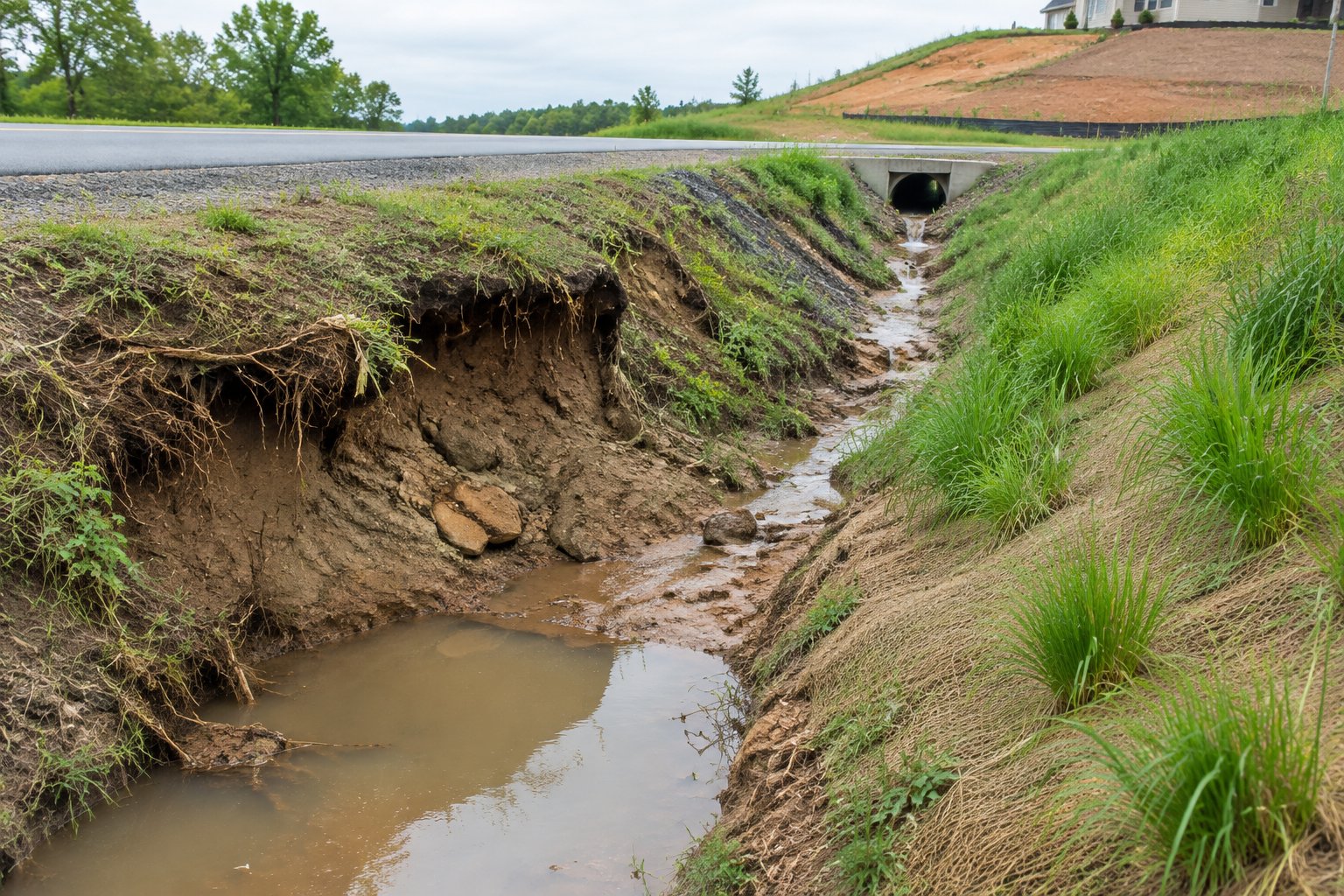
Expansive clay soils, common from Houston to San Antonio, swell when wet and crack when dry. This cycle breaks the bond between mulch and soil, creating runoff channels.
Heavy rain events are frequent in this region. A single storm can dump several inches of rain in hours, stripping unanchored mulch and seed from steep slopes.
Summer heat accelerates drying, shortening the moisture window needed for germination. On south-facing slopes, surface temperatures can climb past 130°F, killing seedlings before they root.
Where Slope Movement Creates Compliance and Schedule Problems
When an unprotected slope erodes, sediment moves offsite. Under TCEQ's construction stormwater general permit, sediment discharge can trigger inspection failures and corrective actions.
A failed slope application means re-mobilizing equipment, re-purchasing materials, and re-applying, often during a closed weather window. On projects governed by TxDOT specifications, failed stabilization can delay final acceptance and extend contract timelines.
The cost of getting the spec wrong on a slope affects grading, paving, and final site closeout.
When Hydroseeding Works and When It Needs Reinforcement
Standard hydroseeding covers a range of slope conditions, but it has clear limits. Knowing those limits helps prevent wasted material and failed applications.
Sites Suited to Standard Hydraulic Mulch Application
On slopes at 3:1 or flatter with stable soils, standard hydraulic mulch performs well. The slurry of seed, mulch, fertilizer, and soil conditioners bonds to the surface and supports germination within 7 to 14 days.
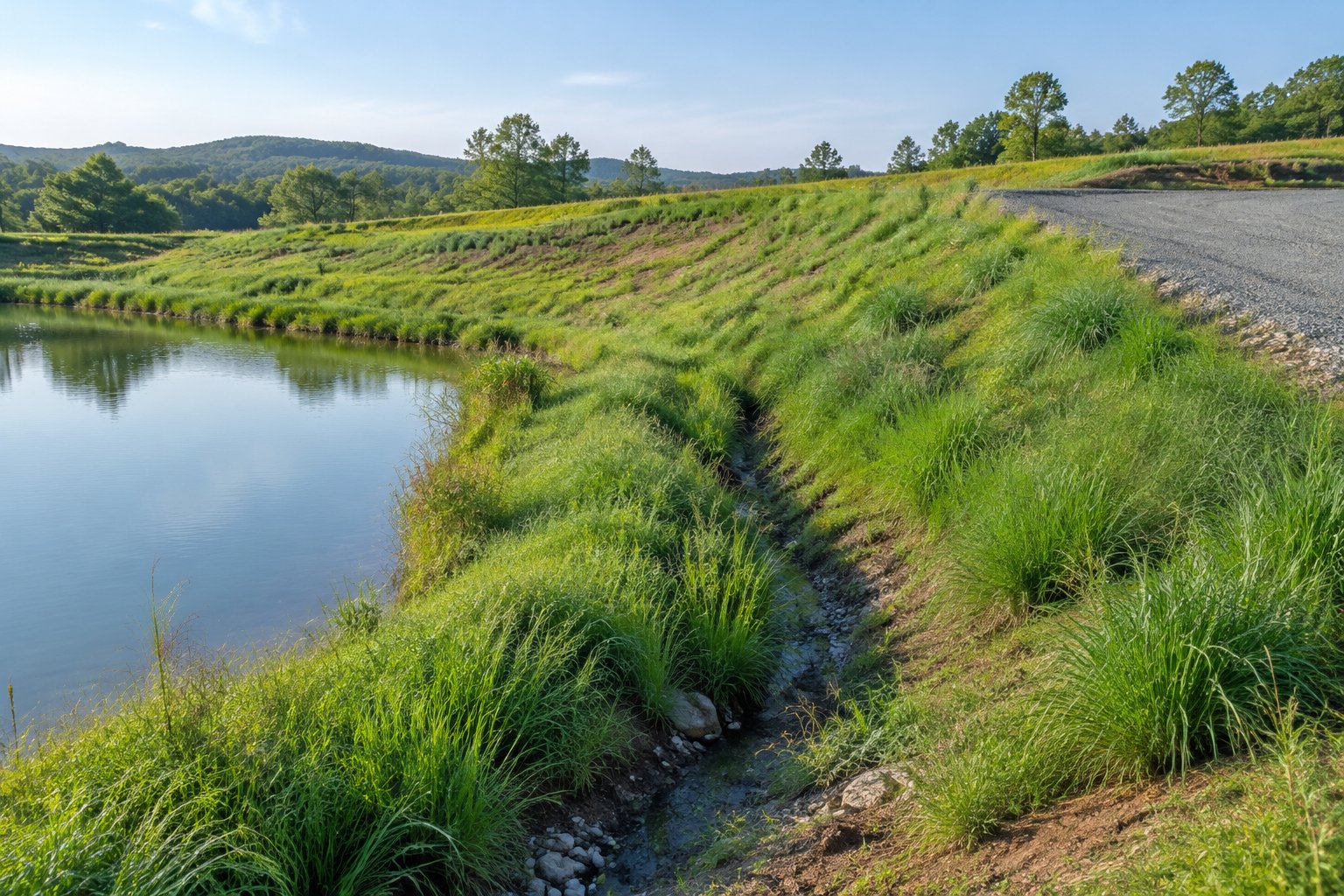
This method works on highway medians with gentle grades, commercial pad sites with mild slopes, and retention pond banks at or below 3:1. Application is fast and cost per square foot stays low compared to blankets or engineered systems.
For sites where fast vegetation on large commercial sites is the goal, standard hydraulic mulch is the starting spec.
When Hydraulic Soil Stabilizers and Flexterra Become the Better Spec
When the grade exceeds 3:1 or soils are unstable, standard mulch alone will not hold. Hydraulic soil stabilizers create a stronger bond with the soil surface and resist runoff.
For severe slopes at 2:1 and steeper, Flexterra HP-FGM consistently performs in Texas conditions. It forms a continuous, interlocking matrix that holds seed in place and maintains contact with the soil through wetting and drying cycles.
Projects with steep embankments along highways or around industrial facilities often require this level of protection for compliance. A detailed look at why severe slopes demand Flexterra HP-FGM covers the performance differences.
Where Erosion Blankets Fit on Steeper Embankments and Drainage Areas
Erosion blankets are specified when the slope needs immediate mechanical protection that does not depend on vegetation. They are pinned or stapled directly to the soil and prevent sheet erosion and rill formation from the moment of installation.
Common applications include drainage channel side slopes, steep highway embankments where TxDOT specs require temporary material, and sites where the weather window for germination has closed. According to TxDOT's surface protection methods, temporary erosion control material becomes necessary as slopes increase beyond 4:1 depending on soil type.
Blankets are often combined with hydroseeding. The seed slurry is applied first, then the blanket is installed over the top, providing both biological stabilization and mechanical protection.
How Drill Seeding Compares on Large or Challenging Slopes
Drill seeding places seed directly into the soil at a controlled depth using specialized equipment. On large, accessible slopes, drill seeding produces strong, uniform germination.
It is commonly specified on infrastructure corridors, reclaimed land, and large acreage projects where equipment access is possible. Germination typically begins within 1 to 3 weeks.
Drill seeding pairs well with native grass species that need consistent planting depth. On steep or confined slopes where drill equipment cannot operate, hydraulic methods are the only practical option.
The decision between methods often comes down to terrain access, soil type, and how quickly the site needs to be stabilized.
How Contractors Evaluate Method Options for Slope Performance
The right method for a sloped site depends on soil conditions, access constraints, and the stormwater exposure window. Evaluating these factors before writing the spec prevents costly mistakes.
Matching the Method to Soil Type, Access, and Stormwater Exposure
Soil type affects product adhesion. Sandy or loose soils drain quickly but provide poor bonding surfaces for mulch. Clay-heavy cut slopes hold moisture longer but increase the weight of saturated soil, raising the risk of shallow slides.
Access determines equipment options. If a hydroseeder truck can reach the slope face, hydraulic application is the fastest path. If the slope is only accessible by hand, erosion blankets may be the only viable approach.
Stormwater exposure is the compliance clock. Sites within TCEQ permit coverage must stabilize disturbed areas within specific timeframes. Projects near sensitive receiving waters face tighter scrutiny.
- Sandy fill slopes with equipment access: Drill seeding or hydraulic soil stabilizer
- Clay cut slopes, 3:1 or steeper: Flexterra FGM or bonded fiber matrix
- Confined slopes with no equipment access: Hand-installed erosion blankets with broadcast or hydraulic seed
- Large acreage with moderate grades: Standard hydroseeding
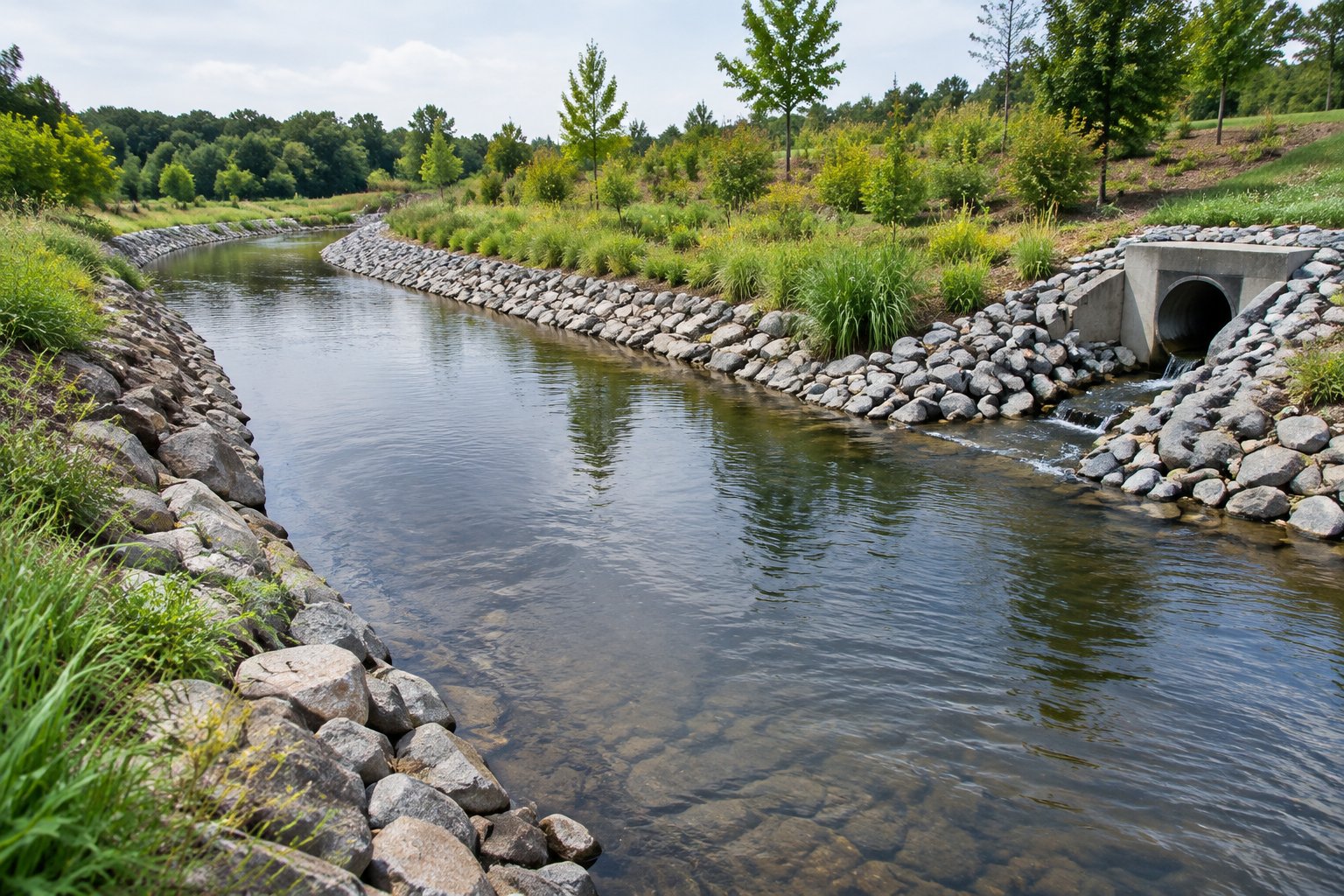
- Drainage channels and retention pond banks: Erosion blankets combined with hydroseeding
Balancing Germination Timing Against Immediate Surface Protection
Germination is not instant. Even under ideal conditions, grass seed needs 7 to 14 days to sprout and 4 to 6 weeks to develop roots strong enough to hold soil.
During that window, the slope is vulnerable. On sites where rain is likely before vegetation establishes, the spec should include immediate mechanical protection.
That means pairing hydraulic application with erosion blankets, or using a product like Flexterra that provides both surface protection and a growth medium. Approaches for reducing runoff risk on steep sites address this dual-protection strategy.
Choosing Between Temporary Protection and Long-Term Vegetation
Some slopes need temporary cover that degrades after vegetation takes hold. Others need permanent, deep-rooted vegetation for long-term stabilization.
Temporary erosion control blankets and hydraulic mulch provide short-term protection, typically lasting one to two growing seasons. For long-term performance on highway embankments, retention pond slopes, or reclamation sites, native grass seeding with species selected for deep root development delivers durable results.
Establishment takes 2 to 3 months, but the outcome is a self-sustaining stand requiring minimal maintenance. Temporary protection is faster and less expensive upfront but may require follow-up seeding. Permanent vegetation costs more initially but reduces the need for re-mobilization.
What to Look For in Slope Stabilization Contractors for Commercial Sites
Field experience on steep slopes is not interchangeable with flat-site seeding experience. The crew's ability to read soil conditions, adjust application rates, and handle equipment on difficult terrain determines whether the application holds after the first rain.
Field Experience on Steep Slopes and Limited Access Areas
A crew with hands-on experience on 2:1 and steeper slopes knows how to adjust hose pressure and nozzle angle to build up product thickness on steep faces without creating runoff channels. They understand where to start and stop application to avoid overloading the top of a slope while leaving the toe exposed.
Limited access areas, such as highway embankments, industrial facilities, and sites with active excavations, require crews comfortable working around traffic control, crane operations, and restricted staging zones. Experience on stabilization projects at refineries, LNG facilities, and major highway corridors sets apart crews that can execute safely from those that slow down the broader project.
Equipment Capacity, Application Quality, and Documentation
The size and condition of the equipment matters. Crews with undersized tanks or worn pump systems need multiple mobilizations to cover the same acreage, increasing cost and extending the schedule.
Ask about tank capacity, daily coverage rates, and pump condition before awarding work. Application quality shows in the finished surface, with even coverage, no bare spots, no pooling at the toe, and no thin areas on the upper slope face.
On projects requiring erosion control for active job sites, consistent application quality is crucial for single-visit success. Documentation is equally important.
On TxDOT projects and any site under a stormwater pollution prevention plan, the contractor must provide records of application dates, product types, coverage areas, and seed mixes used. Crews that neglect documentation create compliance gaps that fall on the GC.
How Regional Knowledge Affects Seed Mixes and Stabilization Results
A crew working Texas and Gulf South projects year-round understands what grows in these conditions and what does not. Seed mixes that perform in the Midwest or Southeast may fail in Houston's clay soils or struggle through a Corpus Christi summer.
Regional knowledge means selecting warm-season grasses like Bermuda or buffalograss for quick establishment, or specifying native species like switchgrass and indiangrass for long-term reclamation projects where drought tolerance and deep root systems matter. Timing also matters.
Seeding a slope in July without irrigation support is a different proposition than seeding in October when soil temperatures and rainfall patterns favor germination. Crews with this knowledge adjust their approach by region and season, not just by spec.
That expertise becomes especially important when the question shifts from surface stabilization to whether the slope itself is structurally sound, which changes the entire scope of work.
Where Erosion Control Ends and Geotechnical Repair Begins
Surface erosion control protects soil from rain, wind, and runoff. It does not fix a slope that is actively moving, sliding, or structurally failing.
Recognizing the difference early saves the project from applying seed and mulch to a surface that will not stay in place long enough for vegetation to establish.
Signs the Site Needs More Than Surface Stabilization
Certain visual and physical indicators signal that the slope problem runs deeper than surface erosion:
- Tension cracks at the top of the slope, running parallel to the crest
- Bulging or displacement at the toe of the slope
- Trees, fence posts, or utility poles tilting downhill
- Sudden acceleration of erosion after a rain event, with large volumes of soil moving at once
- Standing water or seepage emerging from the slope face
- Separation between the slope surface and adjacent structures, pavements, or retaining features
Any of these conditions suggests the slope is experiencing mass movement, not just surface wash. Applying hydroseeding or erosion blankets to an actively failing slope is wasted money and wasted time.
When the Fix Calls for Engineered Earth Retention
When a slope is failing due to inadequate bearing capacity, groundwater pressure, or overloading, the fix is a geotechnical engineering problem, not a seeding one. Solutions such as soil nailing, tieback anchors, retaining walls, and reinforced soil slopes are designed by geotechnical engineers and installed by specialty crews, sized to the soil conditions and loads at that specific site.
That work falls outside erosion control. Allied's role begins once the slope is structurally stable: the surface stabilization, hydroseeding, or Flexterra application that protects the finished grade and establishes lasting vegetation.
Why Active Failures Need Engineered Repair Before Seeding
Applying vegetation to a slope with active movement does not stabilize anything. The root systems of newly germinated grass cannot resist the forces involved in a slope failure.
Seeding should follow geotechnical repair, not replace it. The proper sequence on a failing slope is assess, engineer, repair, then seed. Once the slope is structurally stable, surface stabilization through hydroseeding, erosion blankets, or Flexterra creates the final protective layer that prevents future surface erosion and supports long-term vegetation.
Knowing where the line falls between surface protection and structural repair prevents costly mis-specification and points the project to the right solution from the start.
Making the Right Specification Before the Schedule Slips
Selecting the right slope stabilization method and the right crew to execute it is a decision that compounds across the project timeline. Getting it right the first time avoids re-mobilization, re-application, and the compliance exposure that comes with an unprotected slope sitting through a rain event.
Questions To Resolve Before Awarding the Work
Before issuing a purchase order or subcontract for slope stabilization services, the project team should have clear answers to these questions:
- What is the actual slope grade, measured at the steepest section, not averaged across the site?
- What is the soil type at the surface and at depth? Has geotechnical data been reviewed?
- Is the slope a cut, a fill, or a combination? Fill slopes on clay behave differently from cut slopes in sandy loam.
- What is the stormwater permit status, and what stabilization timeline does it require?
- Does the scope call for temporary protection, permanent vegetation, or both?
- Can equipment access the slope face, or is the work limited to hand installation and hose-reach application?
- Has a geotechnical engineer confirmed the slope is structurally stable, or are signs of mass movement present?
Answering these questions before soliciting bids ensures the spec matches the site, the pricing reflects actual conditions, and the crew shows up with the right product and equipment on the first visit.
Coordinating Multiple Methods Across One Site
Projects with slope stabilization needs often involve multiple erosion control methods across a single site. Flat pads may need standard hydroseeding while adjacent embankments require Flexterra or erosion blankets.
Understanding how bonded fiber matrix outperforms standard mulch helps the project team write a spec that accounts for varying conditions across the site. For contractors managing stormwater compliance alongside slope work, practical guidance on preventing permit holds with erosion control connects the stabilization scope to the broader compliance timeline.
Frequently Asked Questions
What site conditions tell you a slope is at risk of failure or continued erosion?
Tension cracks running parallel to the slope crest, bulging at the toe, tilting vegetation or structures, and seepage from the slope face all indicate instability beyond surface erosion. If runoff carves rills or channels within hours of a rain event, the current protection is insufficient for the grade and soil type.
Which stabilization methods make sense for steep cut slopes versus fill slopes?
Cut slopes expose native soil that is often more cohesive but may have weak layers or seepage planes. Fill slopes are built with placed material that may not be fully compacted. Cut slopes at 2:1 or steeper typically need Flexterra FGM or erosion blankets. Fill slopes in loose material may need hydraulic soil stabilizers combined with anchored blankets.
How do you size and place soil nails, tiebacks, or anchors for long-term performance?
Soil nails, tieback anchors, and rock bolts are engineered solutions designed by geotechnical engineers based on slope geometry, soil shear strength, groundwater conditions, and surcharge loads. These are not erosion control measures. They address structural slope stability and require site-specific geotechnical investigation and design before installation.
When is rockfall protection needed, and what systems are typically specified?
Rockfall protection is needed when cut slopes expose fractured rock that can detach and fall onto roadways, structures, or work areas. Common systems include rock scaling to remove loose material, draped mesh to contain falling debris, rock bolts to anchor unstable blocks, and catchment barriers at the toe. These are geohazard mitigation measures specified by engineers, not erosion control contractors.
What permitting, stormwater, and right-of-way constraints impact slope repair work in Texas?
Any construction activity disturbing one or more acres of soil in Texas requires coverage under TCEQ's Construction General Permit (TXR150000), including a stormwater pollution prevention plan. TxDOT projects add seed mix specifications, erosion control material requirements, and inspection documentation. Right-of-way work may restrict staging areas and equipment access, affecting method selection.
What drives the cost and schedule on a slope stabilization scope, and how is it typically bid?
Cost depends on slope grade, total square footage, soil conditions, product specification, and site access. Steeper slopes with limited access cost more per square foot because they require higher-performance products and slower application rates. Most scopes are bid per square foot or per acre with separate line items for mobilization, product type, and any blanket installation.
Getting Slope Stabilization Right the First Time
Getting slope stabilization right is a one-shot decision on most commercial projects. The method, the product, and the crew all need to match the site conditions the first time, which takes a contractor with direct field experience on steep Texas slopes.
Allied Hydromulch TX, LLC has stabilized slopes on commercial, industrial, and infrastructure sites across Texas, Louisiana, Oklahoma, and New Mexico since 1990. Call 281-482-8212 for a fast quote, or use the online cost estimator to get a starting number before your next site walk.