.svg)


A bare slope steeper than 3:1 on an active construction site quickly leads to sediment loss, stormwater violations, and extra work. Every rain event moves exposed soil downhill.
The steeper the grade and the longer it sits unprotected, the faster the problem grows. Erosion control for steep slopes is a critical early decision that determines whether a project stays on schedule or faces delays at inspection.
Choosing the wrong stabilization method for the slope ratio, soil type, and rainfall exposure can be as costly as doing nothing. A standard hydromulch application that works on a 4:1 pad may wash off a 2:1 cut slope after the first storm.
Over-specifying blankets or structural measures on a moderate grade wastes both budget and crew hours. The method must match the site, and the crew must know the difference.
Slope angle, soil conditions, and project type determine the right erosion control approach. This guide explains hydroseeding, hydraulic soil stabilizers, Flexterra, erosion blankets, and structural options so you can match each tool to the slope and keep your site moving forward.
Why Steep Slopes Fail on Active Job Sites
Gravity, water, and bare soil combine to make steep slopes fail faster than many site teams expect. A graded embankment may look stable on a dry day but can lose inches of topsoil after a single heavy rain.
How Runoff, Gravity, and Bare Soil Accelerate Slope Erosion
Water moves faster on steep grades. As velocity increases, the water carries more soil particles downhill.
On a 2:1 slope, runoff can reach erosive speeds within seconds during a moderate storm. Bare soil offers no resistance: no root structure, no mulch layer, and no roughened surface to slow the flow.
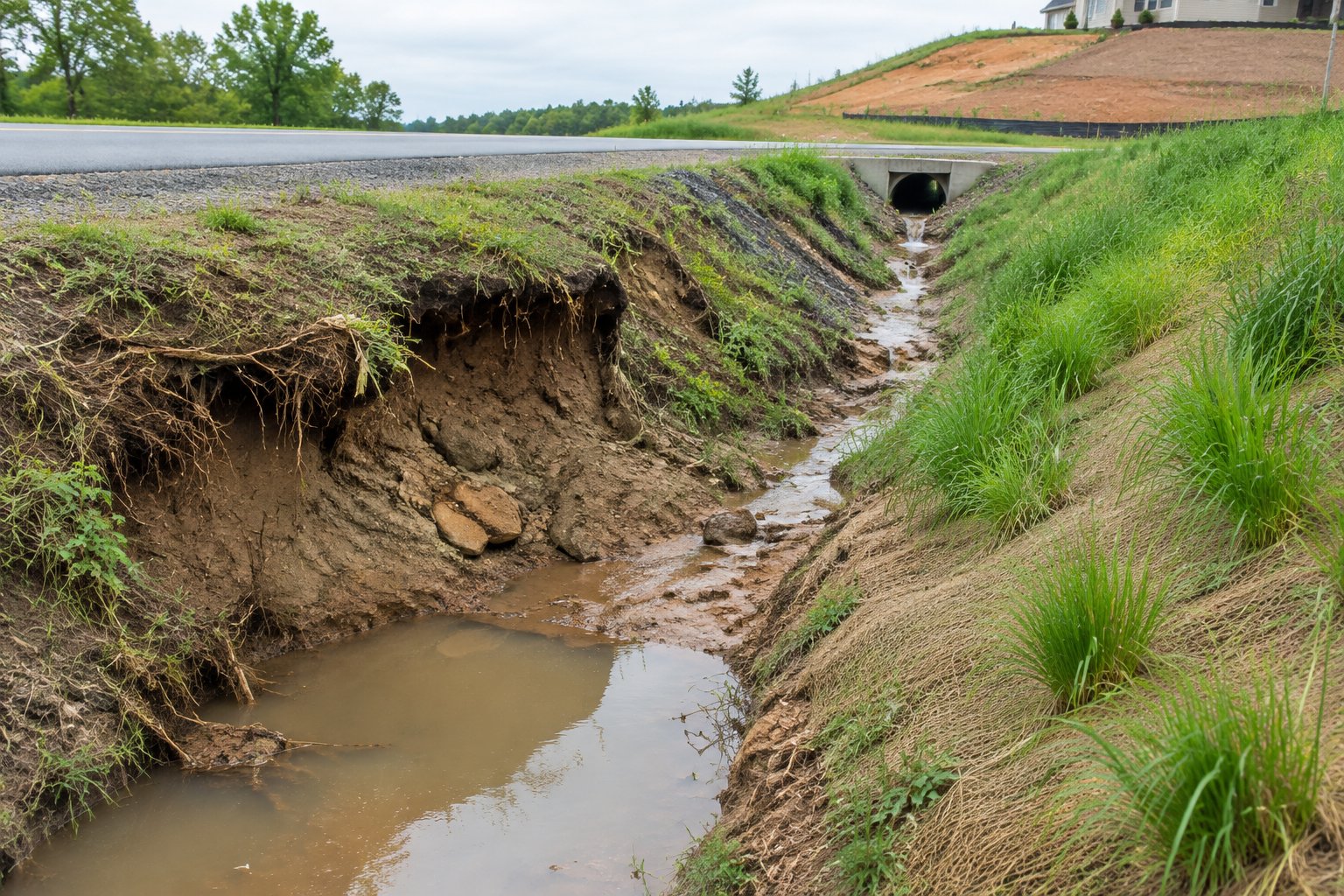
Rill erosion starts with thin channels where water concentrates. These channels deepen with each rain event.
If left unchecked, rills become gullies that undermine the slope and deposit sediment into drainage structures, ponds, and nearby properties. Protecting exposed soil from rain is the first line of defense against this cycle.
Gravity makes the problem worse. Saturated soil on a steep face becomes heavier and less cohesive.
Shallow slumps and sloughing can occur even without surface runoff if the soil stays wet long enough. The combination of surface erosion and mass movement makes steep slopes the highest-risk features on most job sites.
Why Soil Type and Slope Ratio Change the Risk Profile
Not every 3:1 slope behaves the same. A sandy loam on a 3:1 grade drains quickly but erodes easily under sheet flow.
A heavy clay on the same grade sheds water and resists infiltration, causing faster runoff and deeper rills. Texas Gulf Coast sites often deal with expansive clay soils that swell when wet and crack when dry.
These cracks channel water into the slope, accelerating internal erosion that may not be visible until a section fails. Sandy soils along coastal areas drain too fast and lack the cohesion to hold a steep face without reinforcement.
Slope ratio affects how much energy water carries at the bottom. A 4:1 slope allows for simpler erosion control methods.
A 2:1 or steeper grade requires products and techniques that can resist both surface erosion and the pull of gravity on saturated soil. Understanding both the soil and the slope ratio helps you choose a method that works.
Where Inspection Failure and Sediment Loss Show Up First
Inspectors check the bottom of the slope first. That is where sediment builds up, silt fences get overloaded, and failed erosion control is most obvious.
A sediment plume in a drainage channel or pond signals a problem during a stormwater compliance inspection. The next most common place for failure is at concentrated flow points: where two slopes meet, where a bench drain meets a chute, or where runoff leaves the site.
These areas receive the most water and sediment. If the erosion control system does not address flow concentration, the slope may look fine in most places but fail where it matters to the inspector.
Permit holds from failed inspections can stall grading, paving, and construction. Knowing where failure appears first helps you select the right stabilization method.
How to Match the Stabilization Method to the Slope
The right erosion control method depends on slope ratio, soil type, rainfall, and how long the slope will remain bare before vegetation grows. Using the wrong product for the grade is a common reason slopes fail before inspection.
Slope ratio | Typical method
- 4:1 or gentler | Standard hydroseeding
- 3:1| Hydroseeding with tackifier or a hydraulic soil stabilizer
- 2:1 to 1.5:1 | Flexterra or bonded fiber matrix, often paired with blankets
- Concentrated flow, channels | Erosion control blankets or turf reinforcement mats
- Too steep for vegetation alone | Structural: retaining walls, terracing, riprap, geocell
When Hydroseeding Alone Is Sufficient
Standard hydroseeding works well on slopes at 4:1 or gentler, where the soil allows good infiltration and the site does not face concentrated flow. The slurry of seed, mulch, fertilizer, and soil conditioners creates a mat that holds moisture and supports germination, usually within 7 to 14 days under good conditions.
On moderate grades with loamy or sandy loam soils, hydroseeding provides fast commercial vegetation at a lower cost than sod or blanket systems. Surface preparation is key: roughen the soil so the slurry bonds and does not wash away during the first rain.
Hydroseeding alone is not enough when the slope is steeper than 3:1, when the soil is heavy clay, or when storms are likely before roots can anchor. In these cases, a higher-performance product is needed.
When Hydraulic Soil Stabilizers or Flexterra Are the Better Fit
Hydraulic soil stabilizers fill the gap between standard hydromulch and physical blankets. They bond to the soil surface and create a stronger erosion-resistant layer for steeper grades and heavier rain.
Flexterra is a flexible growth medium (FGM) designed for demanding slope conditions. It interlocks with the soil and stays in place on 2:1 and 1.5:1 slopes, providing immediate protection while seeds germinate.
On Gulf Coast sites with clay soils and sudden storms, Flexterra outperforms standard mulch because it resists the sheet flow that removes regular hydromulch.
The choice between standard hydroseeding and a hydraulic stabilizer or FGM depends on slope ratio and timing. If vegetation must establish before the next rain and the grade is steeper than 3:1, a bonded fiber matrix or Flexterra is the safer choice.
When Erosion Control Blankets Are Needed on Steeper Grades
Erosion control blankets provide physical reinforcement that hydraulic applications cannot. On slopes at 2:1 or steeper, or where concentrated flow crosses the face, blankets hold soil in place while roots develop.
Blankets come in materials like biodegradable straw and coconut fiber or synthetic turf reinforcement mats (TRMs) for permanent protection. The International Erosion Control Association (IECA) has reported cases where erosion blankets stabilized slopes when spray-on products alone could not withstand seasonal weather.
- Biodegradable blankets: for temporary protection on slopes where vegetation will establish within one or two seasons.
- Permanent TRMs: for slopes with concentrated flow, drainage channels, or long-term needs.
- Composite systems: combine a hydraulic application under the blanket for seed-to-soil contact and mechanical surface hold.
Choosing between blankets and hydraulic products is not always a simple choice. Many steep-slope projects use both, and proper installation is as important as product selection.
Installation Priorities That Determine Whether the Slope Holds
The product on a steep slope only works if the prep work is done right. Surface preparation and drainage control before application make the difference between a slope that passes inspection and one that fails in the first storm.
Surface Preparation and Drainage Before Any Application
Rough grading is not enough for a steep slope. The soil should be roughened across the slope, either by running equipment treads up and down or by creating horizontal grooves to slow water and help mulch or blankets grip.
Drainage must be managed before any erosion control is installed. If water from above is not diverted, even the best blanket or FGM will fail.
Bench drains, diversion berms, and slope drains move water away from the slope face. Check dams placed in temporary channels at the bottom slow water and capture sediment before it leaves the site.
On Texas clay soils, timing matters. If the surface dries and cracks before application, those cracks create paths for water to bypass the erosion control.
We time prep and application around the soil and weather to avoid this problem. Runoff risk on steep sites starts with getting drainage right before seeding.
Erosion Blankets Installation Sequence on Commercial Slopes
Incorrectly installed blankets can fail as quickly as no blankets at all. The installation sequence prevents water from getting under the material.
Start at the top of the slope. Anchor the blanket into a trench at the crest, backfill, and compact the trench.
Unroll the blanket downslope. Overlap seams in the direction of water flow so runoff passes over the joint.
Staple or stake the blanket at the intervals the manufacturer recommends. Spacing is closer on steeper grades.
- Anchor trenches at the top and bottom of the slope, at least 6 inches deep.
- Longitudinal overlaps of at least 4 inches, shingled with the flow.
- Staple spacing typically 3 to 4 feet on slopes steeper than 3:1.
- Check slots or horizontal anchor trenches at mid-slope for long runs.
Skipping the top anchor trench is the most common installation mistake. Water gets behind the blanket at the crest, lifts the material, and the entire run can fail from the top down.
Every crew member must understand the correct sequence.
How Coverage, Anchorage, and Water Management Work Together
Full coverage means no gaps, no exposed soil at overlaps, and no places where the blanket lifts from the surface. Even a small gap can focus water and erode underneath the blanket.
Anchorage is more than staple count. Staples or stakes must go into firm soil, not loose fill that pulls out.
On clay slopes, stakes driven after rain may hold better than those driven into dry soil. On sandy slopes, longer staples or J-hooks provide the holding power needed.
Water management completes the system. The blanket protects the slope face.
Bench drains and diversion berms keep concentrated flow off the face. Check dams and sediment traps at the bottom capture what does move.
Ground cover, whether from hydroseeded vegetation or native grass, provides long-term protection as temporary measures break down. When all three layers work together, the slope holds through storms and inspections.
Structural Measures for Slopes That Need More Than Vegetation
Some slopes are too steep, too tall, or too unstable for vegetation and blankets alone. Structural measures add the mechanical resistance needed for grades where gravity and soil conditions exceed other methods.
When Retaining Walls or Terracing Enter the Scope
Retaining walls become necessary when the slope exceeds the angle of repose for the soil, when right-of-way limits prevent grading back to a stable slope, or when a vertical elevation change makes a continuous slope face unworkable.
Segmental block walls, mechanically stabilized earth (MSE) walls, and gabion structures each serve this purpose depending on height, load, and appearance.
Terracing divides a long, steep slope into shorter segments separated by flat benches. Each bench captures runoff, slows water, and provides a stable area for plants to grow.
TxDOT slope stabilization guidance recommends reducing slopes when possible to make maintenance easier and lower the risk of erosion. A 4:1 slope is the preferred maximum grade for vegetated surfaces.
The geotechnical report and site limits typically drive the decision to add walls or terraces. Once designers include these structures, erosion control focuses on protecting the exposed areas between and below them.
Where Riprap Fits on Channels, Outfalls, and Embankments
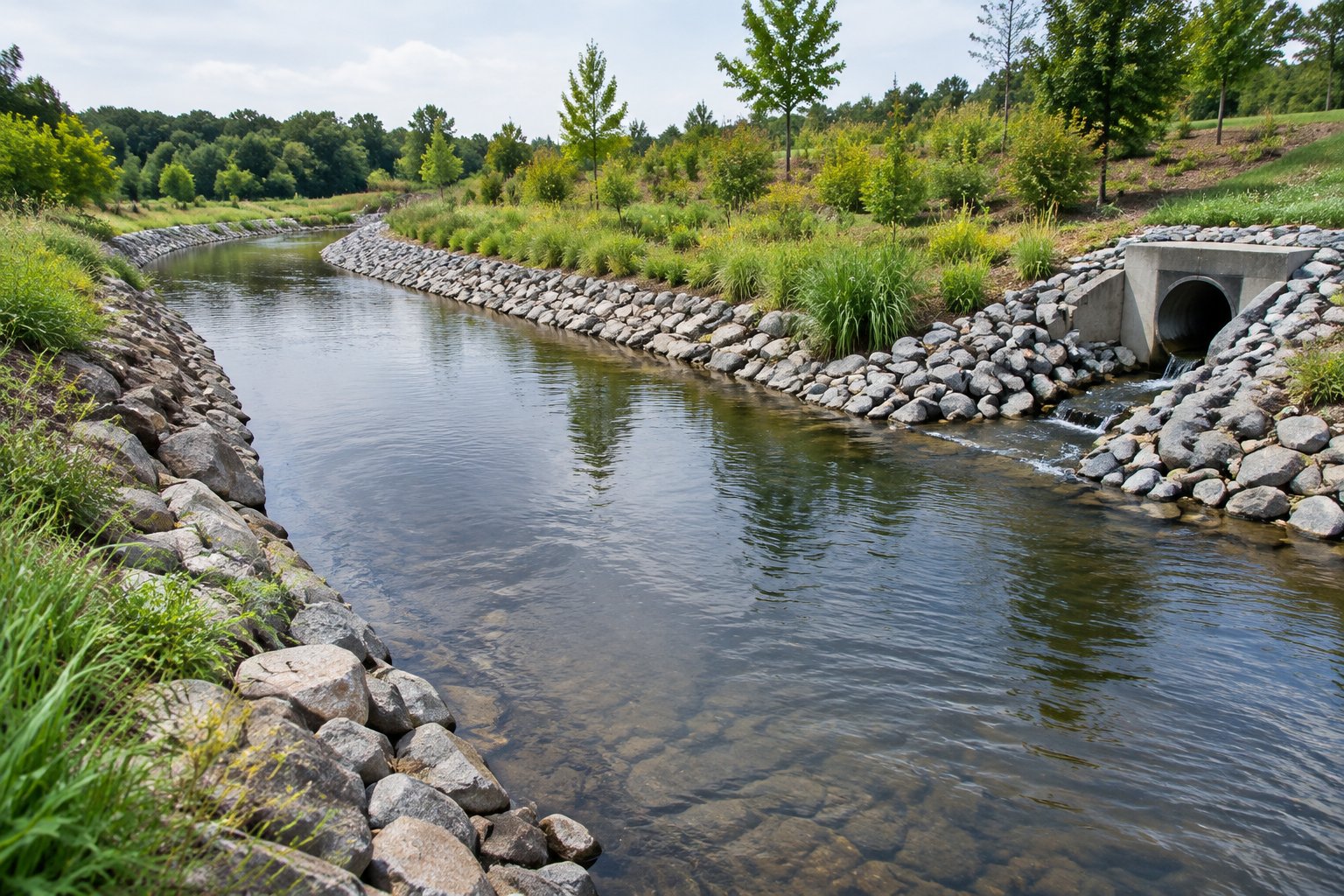
We place riprap, or loose stone, in high-energy areas where water velocity or wave action would remove vegetation or blankets. Riprap is a point-protection solution for channels, outfalls, pipe discharge aprons, and the base of steep embankments where concentrated flow exits.
On Texas highway embankments, riprap lines the area between the graded slope and the drainage ditch or culvert outfall. Without riprap, discharged water can erode the base of the slope and undermine the embankment.
Choosing the right stone size is important. Stones that are too small move during high flows. Stones that are too large cost more and are harder to place.
Riprap only protects the specific points where water energy is highest. It does not prevent erosion above the armored zone. The slope face above still needs hydroseeding, blankets, or stabilizers to prevent erosion and help plants establish.
How Geocell Supports Long-Term Slope Protection
Geocell is a three-dimensional system that holds soil or aggregate in place on steep slopes. Each cell forms a pocket that stops the infill from moving sideways, turning a loose surface into a stable, reinforced layer.
On slopes where soil alone will not stay in place, geocell keeps the growing medium on the slope long enough for vegetation to take hold. We use geocell on highway cut slopes, landfill caps, mining sites, and steep embankments where long-term stability is important.
Geocell works together with vegetation. We fill the cells with soil and seed them, often using hydroseeding to add seed, mulch, and fertilizer to each cell. The structure protects young plants from being washed away while roots develop and eventually anchor the system.
Common Commercial Applications Across Texas and the Gulf Coast
Steep-slope erosion control is common on commercial and infrastructure projects across Texas and the Gulf South. The method used depends on project type, regulatory requirements, and site conditions.
Erosion Control for Highway Embankments and Roadside Grades
Highway embankments are among the most common steep-slope applications in Texas. Cut slopes along new corridors, fill slopes at ramps, and median grading all create exposed surfaces that need stabilization before final inspection.
The Texas Department of Transportation (TxDOT) requires approved erosion control products and vendors that have passed field tests. Using a product not on the approved list can stop a project at the review stage.
Roadside hydroseeding for corridor stabilization is a fast way to meet vegetation requirements if the slope is suitable for hydraulic application.
On steeper grades, a combination of Flexterra or bonded fiber matrix and erosion blankets may be required. The project engineer chooses the method based on slope ratio, soil, and expected time to vegetation. Crews familiar with TxDOT's requirements can match the application to the specification.
Stabilizing Drainage Swales, Retention Areas, and Disturbed Slopes
Drainage swales and retention areas need erosion control that resists channel-flow velocities, not just sheet flow. On commercial sites, swales often run along the edges of building pads, parking lots, and access roads. They move stormwater to detention or retention ponds.
If a swale erodes, sediment can enter the pond, reducing storage and causing compliance problems. Hydroseeding the swale with a strong seed mix and mulch creates ground cover that slows water and filters sediment.
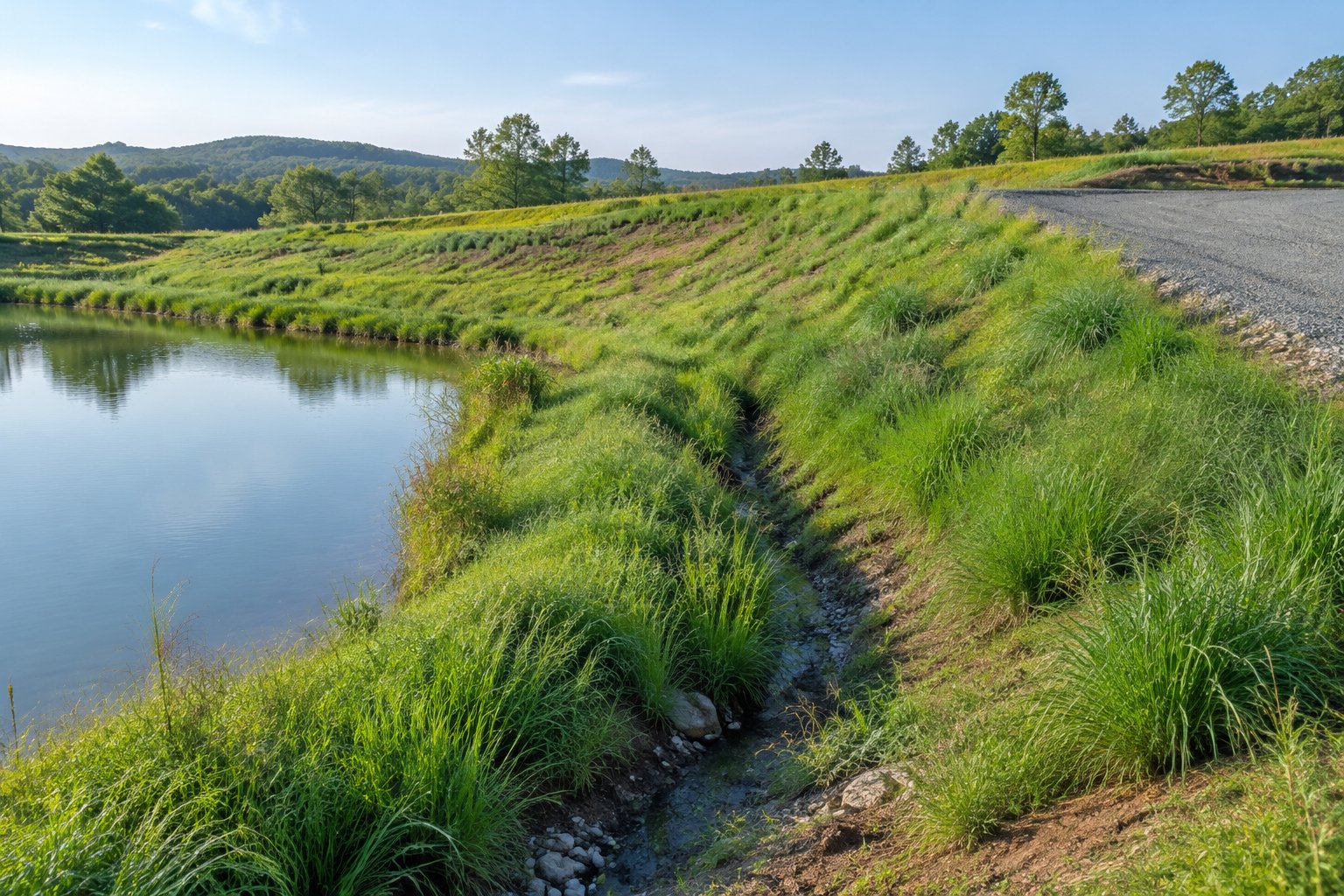
Retention pond embankments are steep by design. The inside slopes must resist waves and changing water levels. The outside slopes must resist rainfall erosion.
Blankets, riprap at the waterline, and hydroseeding on the upper slope often work together. Disturbed slopes from grading on warehouse pads, solar farms, and industrial sites need similar stabilization, though timelines may be shorter.
What Changes on Gulf Coast Sites with Clay Soils and Heavy Rain
Gulf Coast projects face two main challenges: expansive clay soils and heavy seasonal rainfall. Clay soils swell when wet and shed water instead of absorbing it. This causes faster, more concentrated runoff and can wash away standard hydromulch.
Houston and Corpus Christi sites often get 4 to 6 inches of rain in one event during hurricane season. A slope seeded on Monday may be washed out by Wednesday.
Flexterra and bonded fiber matrix products are specified more often in these areas because they stay in place during heavy rain, unlike standard mulch.
Clay also cracks during dry spells. When rain returns, water quickly enters these cracks, increasing pressure inside the slope and causing shallow slides.
We time applications around the weather and use products that seal the surface. Erosion control on Texas sites requires understanding these regional factors before choosing a method.
Making the Right Call Before Weather and Inspections Catch Up
The best erosion control measures are put in place before the first storm, not after problems appear. Waiting to see how a slope performs in rain leads to permit holds and extra costs.
Questions to Ask Before Selecting a Slope Treatment
Start with the slope itself. What is the ratio? What is the soil? How long will it be exposed before plants can grow? These questions quickly narrow product choices.
- What is the slope ratio (3:1, 2:1, steeper)?
- Is the soil sandy, clay, or mixed, and how does it act when wet?
- How long between grading and expected vegetation?
- Does concentrated flow cross the slope, or is it just sheet flow?
- What are the stormwater permit requirements for this project phase?
- Is the slope temporary or permanent?
Answering these questions before requesting a quote saves time and avoids using the wrong product for the slope or soil.
How to Balance Immediate Protection with Vegetation Establishment
Immediate protection and long-term vegetation are separate goals that must work together. The erosion control product holds soil from day one. The seed underneath provides permanent roots as temporary materials break down.
On a 4:1 slope with good soil, hydroseeding can handle both needs in one step. Germination usually starts within 7 to 14 days, with the mulch protecting the surface during this time.
On a 2:1 slope in heavy clay, a Flexterra application or erosion blanket provides immediate hold while a native grass mix establishes roots over 2 to 3 months.
It is important to layer both solutions. Using only a blanket without seed gives temporary protection but no permanent cover. Using only seed on a steep slope gives future vegetation but no protection during germination.
When to Bring in a Slope Stabilization Contractor
Slopes steeper than 3:1, problematic soils, or projects with stormwater requirements need more than general labor. These tasks require the right equipment, product knowledge, and crew experience.
A Texas slope stabilization contractor brings the necessary equipment for hydraulic applications and the know-how to select and install the right product. This expertise prevents costly rework.
If your site has slopes that need to pass inspection, vegetation that must establish on schedule, and weather that will not wait, bring in a specialist before grading is complete.
Frequently Asked Questions
What Slope Angle or Soil Condition Triggers the Need for Erosion Control Blankets, Turf Reinforcement Mats, or Hydroseeding?
Slopes steeper than 3:1 usually need more than standard hydroseeding. Erosion control blankets are used at 2:1 or steeper, and turf reinforcement mats are needed where permanent lining or high-velocity flow resistance is required. Clay soils that shed water and sandy soils with low cohesion both increase the need for blankets or fiber products, even on moderate slopes.
How Do You Keep Seed and Mulch in Place on a Steep Grade During Heavy Texas Rain Events?
Bonded fiber matrix products and Flexterra growth medium lock onto the soil and resist flow that removes standard hydromulch. Surface roughening before application improves grip. Diversion berms or bench drains at the top keep runoff from crossing the slope. Applying products before storms also lowers the risk of washout.
Which Deep-Rooted, Fast-Establishing Native Grasses Work on Steep Slopes in Texas Soils?
Buffalograss, sideoats grama, and green sprangletop are often used on Texas slopes. They grow quickly and develop deep roots that stabilize the soil. Native grass site restoration uses region-specific seed mixes chosen for the soil and climate. Germination usually starts within 2 to 4 weeks, with full cover developing over 2 to 3 months.
When Should You Use Soil Binders or Tackifiers Versus Compost Mulch on a Steep Slope?
Soil binders and tackifiers work best as a temporary seal when quick protection is needed. They are light, fast to apply, and effective on moderate slopes. Compost mulch adds organic matter and holds moisture but is heavier and harder to keep on slopes steeper than 3:1. On steep slopes with heavy rain, bonded fiber matrix or Flexterra is usually a better choice.
What Site Prep Steps Matter Most on a Steep Slope: Roughening, Tracking, Terraces, or Check Slots?
Surface roughening or tracking across the slope is the most important prep step. It creates small ridges that slow water and help mulch or blankets stay in place. Terraces and check slots break up long slopes where water would otherwise gain speed. The right mix depends on slope length and steepness. A short 3:1 slope may need only tracking, while a long 2:1 slope may need terraces, check slots, and a top-of-slope diversion.
How Long Does It Take for a Hydroseeded Slope to Establish Enough Cover to Meet Typical Construction Erosion Control Requirements?
Germination usually starts within 7 to 14 days for standard hydroseeding. Full ground cover that meets most TCEQ stormwater permit requirements develops within 4 to 6 weeks, depending on weather, irrigation, and soil. Steeper slopes may take longer because moisture drains off faster. Supplemental irrigation or higher-performance mulch can help close the gap.
Get Your Steep Slope Protected Before the Next Rain Event
Every steep slope on an active job site creates a risk until you stabilize it. Choosing the right erosion control method for your slope ratio, soil type, and project timeline keeps sediment in place. This approach also helps you pass inspections and stay on schedule.
Allied Hydromulch TX, LLC has stabilized steep slopes on highway corridors, industrial complexes, and commercial developments across Texas and the Gulf South since 1990. In 2025, we installed 15 million square feet of mulch, and more than 60 clients reported complete satisfaction.
Your site cannot wait. We act quickly. Call 281-482-8212 for a fast project quote, or use the online pricing calculator to get a rough cost range for your slope work.