.svg)


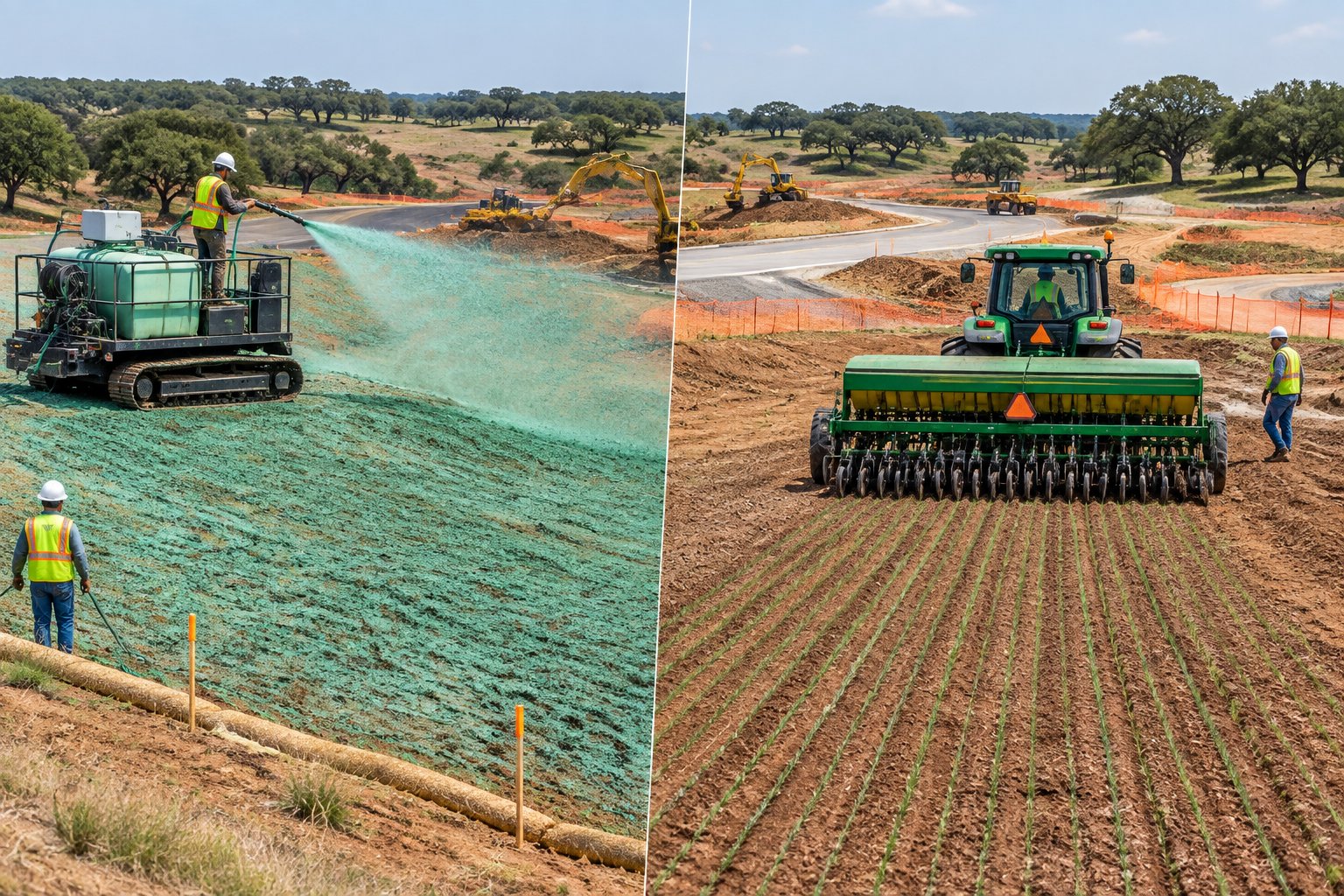
A 40-acre pad site with cut slopes on two sides and silt fence running the perimeter will not accept the same seeding method across every square foot. That is the practical starting point for most contractors weighing hydroseeding vs drill seeding on a Texas job.
Hydroseeding is often the stronger choice on slopes, tight-access areas, and any surface that needs immediate cover, while drill seeding fits open, level ground where a tractor can run clean passes and long-term stand durability matters more than day-one protection. Many large sites in Texas use both, with the seed drill handling the flat acreage and hydraulic mulch covering the embankments, ditches, and areas the drill cannot safely reach.
The decision usually comes down to four site details: slope grade, equipment access, how prepared the soil surface is, and what the project specification actually requires. Get those four right and the method choice becomes straightforward. Get them wrong and you are re-mobilizing after the first heavy rain.
How Each Application Method Places Seed
The two methods put seed in completely different positions relative to the soil surface, and that single difference drives everything else about performance.
How Hydroseeding Applies a Protective Slurry
Hydroseeding sprays a mixed slurry of water, grass seed, fiber mulch, fertilizer, and tackifier onto prepared soil from a truck- or trailer-mounted tank. The seed lands on the soil surface and the mulch layer holds it there.
Tank sizes run large. The Natural Resources Conservation Service describes hydromulching equipment as 1,000 to 3,000 gallon tanks with a pump and continuous agitation system. How far a crew can spray from the truck depends on the equipment and the site.
Key elements of the slurry:
- Fiber mulch holds moisture at the soil surface and shields seed from wind and rain impact
- Tackifier binds the mulch and seed to the ground so the application does not wash or blow off
- Green dye gives the crew a visual record of coverage, which also helps document the treated area for inspection
Hydromulching is a bare-ground application. Existing vegetation, heavy debris, or thick surface rock reduce how well the slurry bonds to soil.
How a Drill Seeder Places Seed in the Ground
A drill seeder is pulled behind a tractor and cuts shallow furrows, drops seed at a set depth, then closes the soil over it. Seed lands below the surface at consistent spacing, which produces uniform seed distribution across the run.
Depth control is the whole point. Roadside vegetation guidance from the Tallgrass Prairie Center warns not to plant native seed deeper than a quarter inch, because most native seeds are small and cannot push through more soil than that.
Drilling is a one-step operation. The tractor makes a pass and the seedbed work, seed placement, and soil closure happen together, which is why it moves fast across open acreage.
Why Seed Placement and Seed-to-Soil Contact Matter
Seed needs firm contact with moist soil to germinate reliably. A drill delivers that contact mechanically on every pass.
Hydroseeded seed sits on the surface inside a mulch matrix, so contact depends on how well the slurry settles and how the soil was prepared. That is why hydroseeding rates are often increased. TxDOT's Dallas District vegetation establishment sheet, for example, directs crews on projects under that sheet to increase the pure live seed rate by 25% when hydroseeding is used in place of drill seed.
The tradeoff is real in both directions. Drilling gives better contact; hydromulching gives immediate surface protection while the stand fills in.
Which Site Conditions Favor Each Method?
Terrain and access decide the method faster than any other factor on a Texas job site.
Hydroseeding for Slopes, Irregular Ground, and Limited Equipment Access
Steep slopes limit drill equipment. As grades steepen, a seed drill can slide sideways, and the disc openers can dig in and bury seed too deep. Where that limit falls depends on the equipment, safe operation, soil conditions, and project requirements rather than one fixed slope ratio. Silt fences create a similar problem, since maneuvering a tractor and drill around them is difficult.
Hydroseeding works from the shoulder or from a hose, so the crew reaches ground the tractor never touches. That covers embankments, cut faces, drainage swales, retention pond banks, and areas boxed in by fence or stockpiles.
For disturbed soil on demanding grades, we specify Flexterra, a flexible growth medium (FGM) built for slopes where standard hydraulic mulch will not hold. Our Flexterra erosion control installation work covers exactly these conditions, and runoff risk on steep sites is where the product earns its cost.
Drill Seeding for Open Areas With Consistent Terrain
Level, uniform ground with clear equipment access is where drill seeding wins. Highway right-of-way, reclaimed land, utility corridors, fields, and large acreage tracts all fit the profile.
Drilling is faster than hydroseeding on big open areas because the hydroseeder has to stop and refill. Depending on the application rate, a single tank load may cover only a fraction of an acre, so a 200-acre restoration tract adds up quickly in fill time.
Cost also favors the drill on level ground, since mulch is a significant material expense on hydraulically applied work. Our drill seeding for large acreage crews run this on reclamation and corridor projects across Texas, Louisiana, Oklahoma, and New Mexico.
How Soil Preparation, Grading, and Drainage Affect the Choice
Both methods need a prepared seedbed. Compacted subgrade, heavy clods, and standing water will fail a stand regardless of how the seed goes down.
Site prep items worth confirming before either method is scheduled:
- Final grading complete, with drainage patterns established and no ponding areas
- Surface scarified or lightly disced so seed can settle into loose soil
- Topsoil or compost amendments placed where the spec calls for them
- Fertilizer applied per spec ahead of seeding
- Rock, debris, and construction spoil cleared from the treatment area
Gulf Coast clay soils crust hard after rain and heat. On tight clay, loosening the top inch before application makes more difference to germination than the seeding method itself.
Vegetation Establishment and Erosion Control Performance
Hydroseeding protects the soil surface on day one; drill seeding produces a durable stand but leaves bare soil exposed until seedlings emerge.
Germination Timelines and Water Management
With favorable temperature and moisture, hydroseeded turf often begins germinating within 7 to 14 days, and a usable cover can develop in 4 to 6 weeks depending on soil temperature, rainfall, and irrigation. Drill-seeded grass often germinates within 1 to 3 weeks under proper conditions. Native grass mixes run longer, and establishment can take several months. These are estimates; early growth is not the same as mature vegetation or final stabilization.
Watering requirements can be substantial in Texas summers. Quantities and timing belong in the project specification. TxDOT's Dallas District vegetation establishment sheet, for example, sets seasonal watering quantities for projects built to that sheet; those figures are requirements of that specification, not general Texas recommendations.
Two scheduling notes that affect both methods:
- Warm season grasses need warm soil to germinate, so the planting window should follow the seed mix and any timing requirements in the specification
- Seeding after rainfall works better than before, since seed and mulch bond to moist soil and mulch needs time to settle
Our hydroseeding germination timeline breakdown covers how these windows line up with closeout schedules.
Surface Protection Before the Root System Develops
Bare soil between application and root development is when most erosion damage happens. Hydromulch closes that gap.
The mulch and tackifier layer intercepts raindrop impact and slows sheet flow, which limits rills forming on freshly graded slopes. A drilled area has no equivalent surface cover, though multiple drill passes create shallow rills that hold seed and interrupt water movement.
Straw mulch applied over drilled ground is a common supplement. TxDOT notes that straw and hay mulch need a tacking agent or crimping to form a mat and keep material from migrating downslope.
When Additional Erosion Control Measures Are Needed
Seeding alone does not satisfy every stabilization requirement. Slope grade, soil type, and channel flow determine whether blankets or a more aggressive hydraulic product belong in the scope.
TxDOT guidance ties product selection to two primary factors: soil type and slope. Soils with higher fine sand or silt content erode more readily, and sheet erosion potential climbs as grade increases.
Situations that usually call for more than seed and mulch:
- Drainage channels with concentrated flow, where soil retention blankets or channel liners are specified
- Steep slopes carrying runoff from paved surfaces
- Sites under active stormwater inspection where cover must be documented immediately
Combining seeding with bonded fiber matrix slope stabilization or blankets is common on these areas.
What to Compare in a Seeding Proposal
Two bids using different methods are rarely comparing the same scope, so the line items matter more than the bottom number.
Seed Selection and Project Specifications
The seed mix drives the method as much as the terrain does. TxDOT Item 164, Seeding for Erosion Control, sets seed mixes by district and by urban or rural condition, with pure live seed rates listed per acre.
Warm season mixes like bermuda grass suit different windows than cool season fescue. Native mixes with fluffy or uncleaned seed often run better through a drill's fluffy seed box than through a hydroseeder pump.
Confirm these items in any proposal:
- Named species and pure live seed (PLS) rate per acre, not just "grass seed"
- Whether the rate was adjusted for the application method
- Mulch type and application rate in pounds per acre
- Tackifier type and rate
- Fertilizer and soil amendment quantities
Our native grass seeding for commercial sites scope is written this way.
Access, Coverage Area, and Application Logistics
Access limits hit the schedule harder than most estimates account for. How far a crew can reach from a road or staging point depends on the equipment, the hose setup, and the ground, so confirm reach for the specific areas on your plan.
A loaded hydroseeder carrying water, mulch, seed, dye, and fertilizer is heavy, and its actual weight depends on the unit and the load. Haul routes, ground conditions, and bridge weight limits belong in planning. Water source location also affects cycle time on remote tracts.
Compare proposals on mobilization count, expected passes, and how the contractor handles areas the primary equipment cannot reach. Single-visit hydroseeding is common on our commercial work, and hydroseeding for large commercial sites in Texas usually runs that way when the site is graded and ready.
How to Evaluate Hydroseeding Cost Against Drill Seeding Cost
Mulch is the main cost separator. Drilling is cheaper than hydroseeding on level ground, and mulch can add substantially to the cost of a seeding project.
That comparison flips when slope, access, or immediate cover requirements enter the picture. A drilled slope that slips and requires reseeding costs more than hydromulch applied once correctly.
Cost factors that move the number on a Texas commercial site:
- Total treated area and how much of it is sloped
- Seed mix cost, which varies widely between native and turf species
- Mulch loading rate and whether a premium FGM is specified
- Number of mobilizations and site access distance
- Supplemental blankets or channel liners in the same scope
Our hydroseeding cost in Texas breakdown walks through commercial budgeting, and Allied's calculator gives a rough estimate for standard hydroseeding based on your project size in square feet.
Selecting the Method That Fits the Site Plan
Match the method to the ground, not to the whole project. Most large Texas sites justify a split scope.
A practical way to sort it on the site plan:
- Flat, open, accessible acreage: drill seeding, for cost and stand uniformity
- Slopes too steep or unstable for safe drill operation: hydroseeding or hydromulch, with FGM where standard mulch will not hold
- Drainage channels and pond banks: hydraulic application plus blankets or liners per spec
- Tight areas, behind silt fence, near structures: hydroseeding from hose
- Roadside corridors under TxDOT spec: whichever Item 164 allows for that district and season
Even on a big restoration tract where drill seeding in Texas makes sense, price hydraulic application for the perimeter and grade breaks. The hydroseeding process and drill placement solve different problems on the same job.
Details to bring when requesting a proposal: total acreage, slope percentages and locations, current grading status, soil type, specified seed mix and rate, irrigation availability, access routes, and any permit or inspection deadline.
Getting the Method Right on Your Next Texas Site
Drill seeding and hydroseeding are not competing choices so much as different tools sized to different ground. Level acreage rewards the drill. Slopes, channels, and access-limited areas need hydraulic application and the surface cover it provides on day one.
The sites that go smoothest are the ones where the seeding scope was set during grading, not after the first inspection notice. Bringing slope maps, seed specs, and your closeout date to the conversation early keeps the stabilization line item off the critical path.
Allied Hydromulch TX, LLC has run hydroseeding, drill seeding, and erosion control across Texas and the Gulf South since April 1990, and we mulched approximately 15 million square feet in 2025 for more than 60 unique clients. Send us your site conditions and specs for a project quote, use our online calculator for a rough standard-hydroseeding estimate based on square footage, or call 281-482-8212 to talk through which method fits each area of your plan.
Frequently Asked Questions
Is Drill Seeding Better Than Hydroseeding for Large Texas Sites?
Drill seeding is usually the better value on large, level tracts with good equipment access, since it costs less than hydroseeding and delivers strong seed-to-soil contact in one pass. Hydroseeding becomes the better option once slopes, silt fence, or tight access enter the picture. Large sites often use both.
Can Drill Seeding Be Used on Steep Slopes?
It depends on the equipment, the slope, and the soil. On steeper grades, a drill can slide sideways and the disc openers can bury seed too deep for emergence, so suitability comes down to the equipment's limits, safe operation, soil conditions, and project requirements rather than one fixed slope ratio. Where drilling is not practical or safe, hydraulically applied mulch, a flexible growth medium, or erosion control blankets handle those grades instead.
Does Hydroseeding Provide Enough Erosion Control on Its Own?
On moderate grades with prepared soil, hydromulch with tackifier provides meaningful surface protection while vegetation establishes. Steeper slopes, concentrated channel flow, and highly erodible sandy or silty soils typically require blankets, channel liners, or a bonded fiber matrix in addition to seeding.
How Long Does It Take for Hydroseed and Drill-Seeded Grass to Germinate?
Under favorable conditions, hydroseeded turf often begins germinating within 7 to 14 days, and a usable cover can develop in 4 to 6 weeks. Drill-seeded grass often germinates within 1 to 3 weeks under proper conditions. Native grass mixes take longer, and establishment can take several months depending on season and rainfall. Early growth is not the same as final stabilization.
What Site Details Should I Provide When Requesting a Seeding Proposal?
Provide total acreage, slope grades and where they sit on the plan, current grading and soil condition, the specified seed mix and pure live seed rate, access routes, and water availability. Add any permit inspection date or closeout deadline so the application can be scheduled around it.